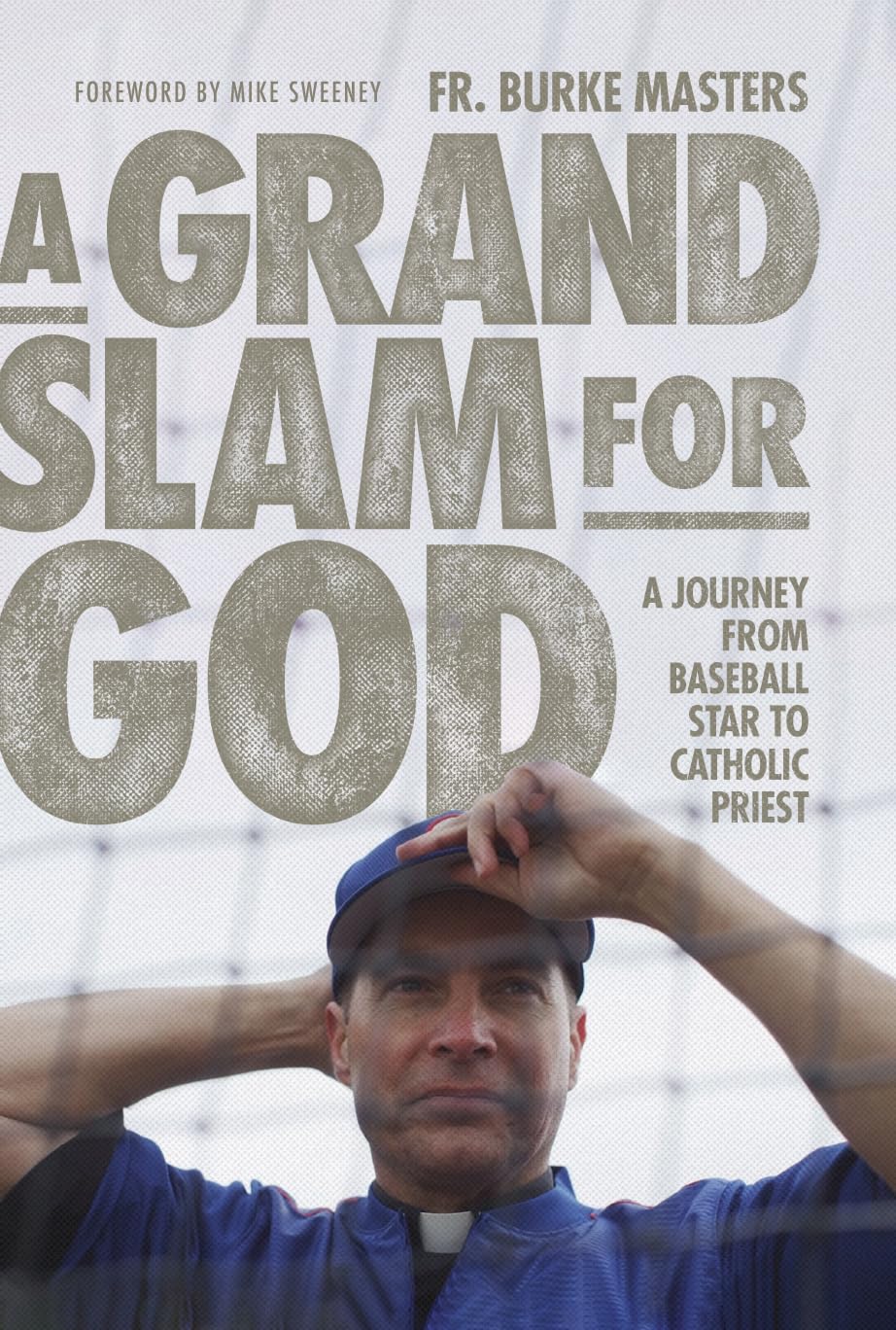
A Grand Slam for God: A Journey from Baseball Star to Catholic Priest
Metadata
- Title: A Grand Slam for God: A Journey from Baseball Star to Catholic Priest
- Author: Burke Masters and Mike Sweeney
- Book URL: https://amazon.com/dp/B0CFGD71TZ?tag=malvaonlin-20
- Open in Kindle: kindle://book/?action=open&asin=B0CFGD71TZ
- Last Updated on: Monday, September 11, 2023
Highlights & Notes
Since meeting Fr. Burke almost ten years ago, he has become a brother, a best friend, and even the godfather of our sixth child, who was named after this heroic priest that my family and I love. The home run–hitting slugger from Joliet, IL, has become a power hitter for Christ. He has replaced his baseball uniform with a black cassock and a Roman collar, his bat with a rosary, and his briefcase with a Mass kit.
It was interesting how the Camino transformed us. The first two weeks, we were focused on getting to the next town. Little by little, we began to enjoy the scenery and the people along the way. The goal came to be less about the destination and more about the journey. We began to enjoy the people and the scenery much more. Life is like the Camino. Hopefully we learn that it’s not just about getting to the next destination, but it’s about the journey.
In the final game of the tournament, I threw a no-hitter, which only added to our championship celebration. It seemed to me that my baseball career was going to hinge around being a pitcher, but I eventually transitioned to being an infielder. When I realized that, in college and beyond, pitchers only played every four or five games, I preferred to play every day as an infielder and hitter. However, the no-hitter was near perfection in that eighth-grade game, and perfection is what I desired.
am grateful that our parents were so involved, supportive, and interested in everything that we did. They encouraged us to do our best. They allowed us to fail in sports and to learn valuable lessons through those failures. They allowed us to live and were not overprotective. They were neither helicopter parents (those who hover over their children) nor Zamboni parents (those who clear the path before their children so they never can fall).
They saw to it that we had a lot of freedom to make mistakes, but they wouldn’t let us crash and burn. Mom and Dad also taught us responsibility and perseverance. If we signed up for something, we had to finish it.
Although we were not a church-going family, we were taught strong, old-fashioned morals, especially how to treat others fairly and charitably.
My lack of formation in the faith as a child could have pushed me to search for it later in life.
Sports and school allowed me to make some good friends, but I did not let anyone get too close to me. I did not like who I was on the inside, so I decided I was going to be perfect on the outside. I convinced myself that only then would everyone like me. I wanted to be the perfect student and the perfect athlete. In both areas I started to get attention, and this only fueled my desire for greater perfection. I thought that if I let anyone know the real me, they would surely run away and not want to be my friend. I certainly did not know who I was at this point in my life. My identity and my worth came from being a good student and a good baseball player.
I was with Mom the day that I realized what my dream and destiny would be. I was about seven when she took my brothers and me to a Cubs game at Wrigley Field. Dad had to work. Because they grew up in southern Illinois, my parents were both diehard fans of the St. Louis Cardinals. They despised the Cubs—also known as the “loveable losers.” We regularly watched them on Chicago’s WGN TV station, and we rooted for whoever was playing against them. I cannot remember who the Cubs were playing that first time we went, but I still remember how enthralled I was by the sights, the sounds, the smells, and the game. The freshly cut grass, the crack of the bat, the stacked hot dogs, the cheers of the crowd, the bright sunshine, and the pure athleticism of the players on the field drew me. I thought to myself, “This is what I want to do when I grow up.” I wanted to be a part of this atmosphere forever. If I could play baseball and make a living doing it, that would be perfect. That day, like millions of young boys in America, I decided I was going to be a Major League Baseball player. I said to myself, “I’m going to be on this field one day.” So I dedicated myself to becoming the best player I could be. Baseball became my passion. I kept score at home while watching the Cubs games. I played whenever I could. I ate, slept, breathed, and lived baseball. It was decided: I was destined for the majors.
My parents explained that they weren’t happy with the public high school’s baseball program. Both Catholic schools in the area were known both for academic and athletic excellence, as well as discipline and family atmosphere. Even as an eighth grader, I knew that this would be a significant financial expense for my parents. We didn’t have a lot of money, but my parents were willing to make this sacrifice for me and my future. I was touched that my parents even considered it. They believed in me. Dad said that he knew I had a shot at playing college baseball and maybe even further. And either one of these schools would help me get there. Now all that was left was to choose between Joliet Catholic and Providence.
Even though I had what seemed like an idyllic upbringing, nobody’s life is perfect and nobody is without sin. I knew I was a sinner, and I honestly believed I was the only one. Was I the only one with a messed-up life? I thought that if people knew who I was—really knew—they’d run. I was still growing into my identity. Who was I? Was I the result of all my past mistakes? Was I the combination of all my sins? That’s why I unconsciously became a perfectionist. I thought that if I became this person that everyone liked, if I portrayed this perfect image, if I became this person that others wanted me to be, everyone, including God, would love me. Looking back, I realize how much I wanted to be known and to be loved. I couldn’t have articulated that at the time, but I was searching.
St. Augustine, in one of his most famous quotes, said, “We were made for you, Lord, and our hearts are restless until they rest in you.”
That sophomore year I batted .450, broke state records, and received attention locally and nationally. My brothers took it upon themselves to keep me humble. If they saw my name in a newspaper, they would make sure to do or say something to keep me grounded. They wanted to make sure that “my head would fit through the door.”
My friends and I joined Joe and Deb at their home, which students called “The Bat Cave” because it was tucked back at the end of a dead-end street. We had a great time, enjoyed a nice dinner, and played some games afterward. I was impressed because the Rodegheros were normal and yet took their faith seriously. Sometimes I would visit them with my classmates. Sometimes I would visit them alone. I began going to Mass with them on Sundays and accompanying them to some family gatherings. I had a preconceived idea that religious people were weird or boring. But they enjoyed life and sports and at the same time tried to live moral lives and do things the right way.
In November, Coach Polk called me into his office. “Burke, we’re going to redshirt you,” he said. I knew it was common to redshirt freshmen, which meant you could practice but not play in games. You were given five years to play four. Redshirting meant that you would have an extra year to mature. But I never thought that would pertain to me. I expected that since I had such a good fall, I would be in the starting lineup in the spring. Not every freshman was redshirted, and I believed I had earned the right to play.
Sometimes we need to be reminded that our mistakes are not insurmountable. We need to recognize that at times we make errors, but there’s a chance for redemption.
When we get our identity from what we do, it is like riding an emotional roller coaster.
Bo was the equipment manager and introduced me to rotisserie baseball, now called fantasy baseball, which I still play to this day.
We had to win another game to make it to the College World Series. Florida State won their next game against Illinois and then had to beat us twice to get to Omaha. They beat us the next game 11–8, and so it came down to a deciding one-game playoff. We won the final 4–3 in an exciting back and forth game, and we were off to Omaha! I was voted most valuable player of the tournament after going 12 for 14 in the first three games, and 14 for 22 in the series. I could not wait to play in the College World Series, which was one of my goals as a young boy when I imagined playing college baseball.
Even though the College World Series occurred the week after the tournament of my life, I was no longer in the zone. The ball looked like a pea. My first at bat in the first game against our SEC rival Georgia, I hit into a double play, and all my confidence was instantly gone. I felt it switch too. It’s amazing how quickly it can turn. When I was hot, it seemed like nobody was in the field—just the pitcher and me. And if I hit the ball anywhere, it was going to find a hole. When we got to the World Series, it felt like there were forty guys on the field. I knew that no matter where I hit the ball, it was going to get caught. Hitting is so psychological. I got only one hit in three games and made a couple errors.
My parents always encouraged our family to confess our sins straight to God, and I knew God could forgive sins anywhere. God is bigger than a confessional, and he can do anything. But I had learned an important lesson about the sacrament. As a human being, I needed to say these things out loud, and I needed to hear “I absolve you from your sins.” The priest represents Christ here on earth. It was such a cleansing moment for me, and I walked out of the confessional and the weekend feeling light and free. I vowed to myself to make confession a regular part of my spiritual life.
I was suffering from a problem that many young people face: I was of two minds. On one hand, I was hearing God’s invitation, and on the other, I was reluctant to accept it. I didn’t trust God enough to surrender to his will.
They say philosophy is the handmaid to theology: it teaches you how to think and prepares you for the study of God.
I tried to work through the pain, the grief, and the anger in spiritual direction, but it was hard. My perfectionism made grieving difficult. I had a hard time admitting that I wasn’t perfect. I’d get angry at myself for being angry. Good people don’t get angry—this was a lie that I believed.
Through the most difficult times in life, we grow the most.
Most exciting for me was the opportunity to preach homilies. I enjoyed the preparation for preaching: praying with Scripture, reading the Church Fathers, and listening to the homilies of Father (now Bishop) Robert Barron. I experimented with preaching in front of the altar and at the ambo. I didn’t read my homilies but spoke from the heart after much preparation, study, and prayer.
Our culture teaches us to “just do it,” to “follow your dreams,” to “get what you want out of life.” But I have learned that the key to holiness and happiness is to follow the Holy Spirit’s prompting in the present moment.
We serve a God of surprises, and I have learned to expect the unexpected with the Lord. In his perfect way, he was preparing me to become a vocation director to help young people discern their calling.
Everything matters, even things that seem relatively small.
often have to say no to the good so that I can say yes to the great things God has in store.
It is a good and holy desire to help everyone, but we must recognize our limitations and refer people to someone else, like an older priest, a professional therapist, or a well-respected married couple. After my experience with the two women from the parish, I saw the importance of befriending couples in solid marriages. Two people in a holy marriage inspire me to be faithful to my vocation and my call to holiness. And married couples have told me that my faithfulness to my vocation inspires them in theirs.
Pain is always involved when we love and have to move on.
Now when I preach on retreats, I focus on identity as the number one theme. I say to attendees, “What is your fundamental identity? You are a beloved son or daughter of God, and that will never change. Your economic status, your job, and your earthly relationships all might change, but God will always love you because you are his child. You never have to earn his love.” I love to see this truth sink into the hearts of people for the first time, especially someone who has believed the lie their whole life that they are unworthy of the love of God. Our only job is to surrender to God and let him love us, gaze upon us, and delight in us. This truth is life changing. It is revolutionary. It is freeing.
I talked with Nashville Dominican Sister Cecelia Joseph, an original member of my vocation team, about my hesitancy to call out seminarians for their behavior. She explained that I shouldn’t look at it as calling them out, but instead as calling them up. Jesus always called people up. He met people where they were, loved them without condemnation, and then called them to greatness or holiness. Sister said that the guys knew I loved them, but a good father would do what was right for their son no matter how difficult or painful it would seem at first.
Teaching this course allowed me to reflect on the identities of my own priesthood and inspired me to live them out fully. And during my twelve years as vocation director, I had to look in the mirror constantly because I was a spiritual father to these young men. I had to reflect on my own priesthood so that I could be an example for the seminarians. I could not expect them to do anything that I was not living out myself. If I was to mentor these young men, I needed to live a life of authenticity and integrity.
I have done things I never dreamed of, like going on mission trips to Bolivia, the Philippines, and Guatemala and leading pilgrimages to Mexico, Italy, the Holy Land, Spain, France, and Australia.
I had planned to become a professional baseball player, make millions of dollars, and have a big family. God had different plans. He said to me, “Burke, I have more in store for you than you ever imagined. Your family will be gigantic. You will be rich in graces. You will have the opportunity to impact the eternal lives of thousands of people. You will be a Major League Catholic priest.” You cannot outdo God in generosity. I dare you to try!
God continues to return to me everything that I had given up. He has shown me that I hadn’t lost any of my dreams. His dreams were so much bigger than mine. What I didn’t know was how God would bring baseball back into my life.
“Fr. Burke,” he said, “Fr. Jaffe told me about your history and that you live in the Chicago area. Well, we’re in need of a Catholic chaplain for the Chicago …” There seemed like a long pause, and then he said “Cubs.” God really does have a sense of humor. I was hoping that Ray would say “White Sox.” Don’t get me wrong: I was excited for the opportunity. But I was raised to hate the Cubs! My parents and oldest brother Brock were diehard St. Louis Cardinals fans. Blaine had become a Cincinnati Reds fan, and I became a Philadelphia Phillies fan after watching Mike Schmidt hit three home runs against the Cubs one day. The Cardinals and Cubs are fierce rivals. And so are the Cubs and the White Sox. I was on the opposite side of the Cubs in both rivalries. I could imagine my mother rolling over in her grave knowing that I was going to be the chaplain for the Chicago Cubs! All joking aside, I could not believe I was getting another chance to be in the Major Leagues. With a laugh at God’s sense of humor, I accepted the volunteer position.
Mike told me the incredible story of his Catholic Baseball Camps. He said God had inspired him to “tell the greatest story ever told with the greatest game ever played” by sharing the story of Jesus Christ though baseball.
Afterward, the kids had the opportunity to go to confession right on the baseball field. Priests were stationed on each of the bases and the pitcher’s mound. After Mike explained the beauty of the sacrament of Reconciliation, the kids literally ran onto the field for confession. The whole program was a wonderful way to evangelize and share Christ’s love through baseball. I knew I had to bring it back to Joliet.
The Cubs began renovating Wrigley Field after the 2014 season, and they tore out the family room where I had been celebrating Mass. That we no longer had a chapel didn’t stop Christ from coming to Wrigley. Like Mary and Joseph who couldn’t find a room to have their baby, we looked all over Wrigley Field for a proper place to celebrate Mass. With approval, we decided to celebrate Mass out in the seats on the third base line. The people call it the “Cathedral of Wrigley Field.” As I celebrate Mass, tours are going on around us, forklifts are carrying supplies to the concession stands, and airplanes are flying overhead, but more people are attending Mass regularly. God’s hand is at work in this ministry.
Maddon told me he attended Catholic schools his whole life, and whenever a priest walked into the room, everyone began to behave better. “You have my permission to be present anywhere, except in the dugout during the game. Major League Baseball does not allow that,” he said with a smile. I had been to spring training in the past to see a couple Cubs games and to be there for the players. During the 2016 spring training, I ran into Coach Maddon in the locker room. “Fr. Burke,” he said, “do you want to practice with the team tomorrow?” “Really?” I couldn’t believe it! I hadn’t played ball in a while, and I was forty-nine years old. Once I confirmed that his offer was serious, I responded quickly, “Of course!”
The next day, Joe put me in full uniform and had Miguel Montero, who was with the Cubs at the time and had been coming to Mass, take me out on the field. “Just go have fun!” were Joe’s last instructions to me.
I didn’t realize until I looked around that I was on the field with the entire starting lineup of the Cubs: Rizzo, Bryant, Russell, Heyward, Zobrist, Schwarber, Soler, and Montero.
At their Saturday night game against the Los Angeles Dodgers, Miguel hit a grand slam, and the Cubs went on to win. The next morning, Miguel came to Mass in the stands and sat next to popcorn salesmen, beer vendors, and other “regular people.” It was beautiful because in God’s eyes we’re all the same. He doesn’t care that Miguel’s making millions of dollars and the beer salesmen are making minimum wage. We’re all God’s children.
Our life is not defined by one single moment or by one generous act. Life is not one grand slam, surrounded by a bunch of forgettable moments. Every moment that we are given is an opportunity for a grand slam for God. If you offer your life, your gifts, your talents, and your time to him, there is no telling what your story will be. ‡ You can find more information at www.catholicsportscamps.org.