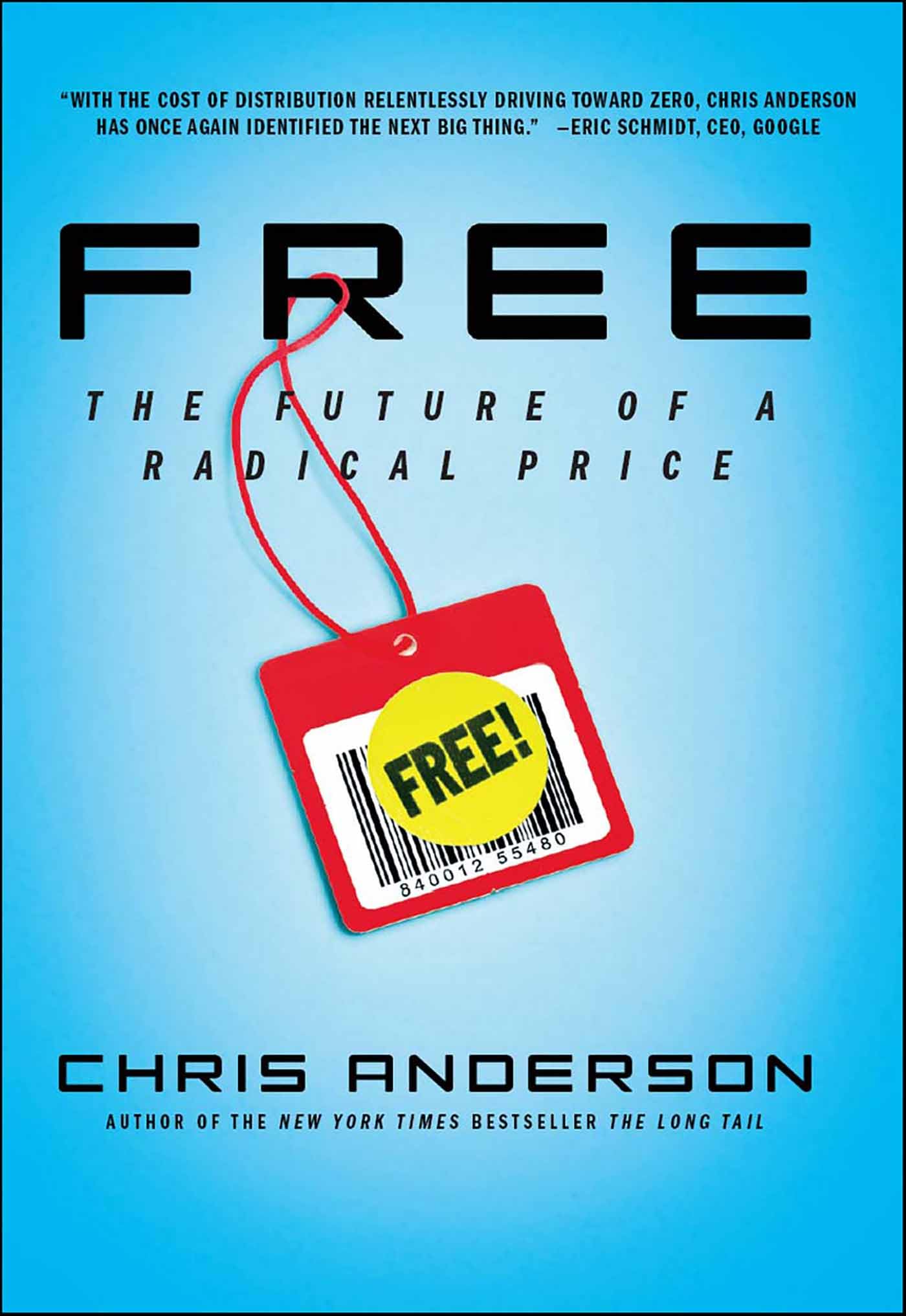
Free: The Future of a Radical Price
Metadata
- Title: Free: The Future of a Radical Price
- Author: Chris Anderson
- Book URL: https://amazon.com/dp/B002DYJR4G?tag=malvaonlin-20
- Open in Kindle: kindle://book/?action=open&asin=B002DYJR4G
- Last Updated on: Thursday, October 29, 2015
Highlights & Notes
Therein lies the paradox of Free: People are making lots of money charging nothing. Not nothing for everything, but nothing for enough that we have essentially created an economy as big as a good-sized country around the price of $0.00.
Twenty-first-century free is different from twentieth-century free. Somewhere in the transition from atoms to bits, a phenomenon that we thought we understood was transformed. “free” became free.
Somehow an economy had emerged around free before the economic model that could describe it.
What’s more, today’s free is full of apparent contradictions: You can make money giving things away. There really is A free lunch. Sometimes you get more than you pay for.
Those who understand the new free will command tomorrow’s markets and disrupt today’s—indeed, they’re already doing it.
Thus was born one of the most powerful marketing tools of the twentieth century: giving away one thing to create demand for another. What Woodward understood was that “free” is a word with an extraordinary ability to reset consumer psychology, create new markets, break old ones, and make almost any product more attractive. He also figured out that “free” didn’t mean profitless. It just meant that the route from product to revenue was indirect, something that would become enshrined in the retail playbook as the concept of a “loss leader.”
A few billion blades later, this business model is now the foundation of entire industries: Give away the cell phone, sell the monthly plan; make the video game console cheap and sell expensive games; install fancy coffeemakers in offices at no charge so you can sell managers expensive coffee sachets.
In the atoms economy, which is to say most of the stuff around us, things tend to get more expensive over time. But in the bits economy, which is the online world, things get cheaper. The atoms economy is inflationary, while the bits economy is deflationary.
Anything free in the atoms economy must be paid for by something else, which is why so much traditional free feels like bait and switch—it’s you paying, one way or another. But free in the bits economy can be really free, with money often taken out of the equation altogether. People are rightly suspicious of free in the atoms economy, and rightly trusting of free in the bits economy. Intuitively, they understand the difference between the two economies, and why free works so well online.
The fastest-growing parts of the gaming industry are ad-supported casual games online and free-to-play massively multiplayer online games.
As a result, the net annual deflation rate of the online world is nearly 50 percent, which is to say that whatever it costs YouTube to stream a video today will cost half as much in a year. The trend lines that determine the cost of doing business online all point the same way: to zero. No wonder the prices online all go the same way.
all forms of free boil down to variations of the same thing: shifting money around from product to product, person to person, between now and later, or into nonmonetary markets and back out again. Economists call these “cross-subsidies.”
In any package of products and services, from banking to mobile calling plans, the price of each individual component is often determined by psychology, not cost. Your cell phone company may not make money on your monthly minutes—it keeps that fee low because it knows that’s the first thing you look at when picking a carrier—but your monthly voice mail fee is pure profit.
A typical online site follows the 5 Percent Rule—5 percent of users support all the rest. In the freemium model, that means for every user who pays for the premium version of the site, nineteen others get the basic free version. The reason this works is that the cost of serving the nineteen is close enough to zero to call it nothing.
In each case, the act of using the service creates something of value, either improving the service itself or creating information that can be useful somewhere else. Whether you know it or not, you’re paying with your labor for something free.
there is sometimes a third price that we can’t ignore: less than nothing. That’s right, a negative price: You get paid to use a product or service, rather than the other way around.
In China, Sivers notes, “some doctors are paid monthly when their patients are healthy. If you are sick, it’s their fault, so you don’t have to pay that month. It’s their goal to get you healthy and keep you healthy so they can get paid.”
In each case, a clever company has reversed the normal flow of money, either making something free or paying for what other companies are charging for. There’s nothing particularly high-tech about any of these ideas. They just took some entrepreneur thinking creatively about price.
But every effort to make this work in practice at any scale failed, largely because the social bonds that police such mutual aid tend to fray when the size of the group exceeds 150 (termed the “Dunbar number”—the empirically observed limit at which the members of a human community can maintain strong links with one another).
Just as we’ve evolved to overreact to threats and danger, one of our survival tactics is to focus on the risk that supplies are going to run out. Abundance, from an evolutionary perspective, resolves itself, while scarcity needs to be fought over.
Just as water will always flow downhill, economies flow toward abundance. Products that can become commoditized and cheap tend to do so, and companies seeking profits move upstream in search of new scarcities. Where abundance drives the costs of something to the floor, value shifts to adjacent levels, something management writer Clayton Christensen calls the “Law of Conservation of Attractive Profits.”
Only thirty-two of the Top 100 companies today make things you can hold, from aerospace and motor vehicles to chemicals and food, metal bending and heavy industry. The other sixty-eight traffic mostly in ideas, not resource processing. Some offer services rather than goods, such as health care and telecommunications. Others create goods that are mostly intellectual property, such as drugs and semiconductors, where the cost to produce the physical product is tiny compared to the cost of inventing it. Yet others create markets for other people’s goods, such as mass retailers and wholesalers.
Why do people think “free” means diminished quality in one instance, and not in another? It turns out that our feelings about “free” are relative, not absolute. If something used to cost money and now doesn’t, we tend to correlate that with a decline in quality. But if something never cost money, we don’t feel the same way. A free bagel is probably stale, but free ketchup in a restaurant is fine. Nobody thinks that Google is an inferior search engine because it doesn’t charge.
What free grants, in exchange for forsaking direct revenues, is the potential of mass sampling.
After examining mental transaction costs, Clay Shirky, a writer and NYU lecturer, concluded that content creators would be wise to give up on dreams of charging for their offerings:
free content is thus what biologists call an evolutionarily stable strategy. It is a strategy that works well when no one else is using it—it’s good to be the only person offering free content. It’s also a strategy that continues to work if everyone is using it, because in such an environment, anyone who begins charging for their work will be at a disadvantage. In a world of free content, even the moderate hassle of micropayments greatly damages user preference, and increases their willingness to accept free material as a substitute.
So from the consumer’s perspective, there is a huge difference between cheap and free. Give a product away and it can go viral. Charge a single cent for it and you’re in an entirely different business, one of clawing and scratching for every customer. The truth is that zero is one market and any other price is another.
Most transactions have an upside and a downside, but when something is free! we forget the downside. free! gives us such an emotional charge that we perceive what is being offered as immensely more valuable than it really is. Why? I think it’s because humans are intrinsically afraid of loss. The real allure of free! is tied to this fear. There’s no visible possibility of loss when we choose a free! item (it’s free). But suppose we choose the item that’s not free. Uh-oh, now there’s a risk of having made a poor decision—the possibility of loss. And so, given the choice, we go for what is free.
This is one of the negative implications of free. People often don’t care as much about things they don’t pay for, and as a result they don’t think as much about how they consume them. free can encourage gluttony, hoarding, thoughtless consumption, waste, guilt, and greed. We take stuff because it’s there, not necessarily because we want it. Charging a price, even a very low price, can encourage much more responsible behavior.
Free is the best way to maximize the reach of some product or service, but if that’s not what you’re ultimately trying to do (Google is not trying to maximize snack food consumption), it can have counterproductive effects. Like every powerful tool, free must be used carefully lest it cause more harm than good.
Build a community around free information and advice on a particular topic. With that community’s help, design some products that people want, and return the favor by making the products free in raw form. Let those with more money than time/skill/risk-tolerance buy the more polished version of those products. (That may turn out to be almost everyone.) Do it again and again, building a 40 percent profit margin into the products to pay the bills.
This is why free works so well in conjunction with Paid. It can accommodate the varying psychologies of a range of consumers, from those who have more time than money to those who have more money than time. It can work for those who are confident in their skills and want to do it themselves, and for those who aren’t and want someone to do it for them. free plus Paid can span the full psychology of consumerism.
The lesson from Harris’s experience is that in a digital marketplace, free is almost always a choice. If you don’t offer it explicitly, others will typically find a way to introduce it themselves. When the marginal cost of reproduction is zero, the barriers to free are mostly psychological—fear of breaking the law, a sense of fairness, an individual’s calculation on the value of his or her time, perhaps a habit of paying or ignorance that a free version can be obtained. Sooner or later, most producers in the digital realm will find themselves competing with free. Harris understood that and figured out how to do it better. With his survey, he looked into the mind of the pirate and saw a paying customer looking for a reason to come out.
In a world where prices always seem to go up, the cost of anything built on these three technologies will always go down. And keep going down, until it is as close to zero as possible.
When the cost of the thing you’re making falls this regularly, for this long, you can try pricing schemes that would seem otherwise insane. Rather than sell it for what it costs today, you can sell it for what it will cost tomorrow. The increased demand this lower price will stimulate will accelerate the curve, ensuring that the product will cost even less than expected when tomorrow comes. So you make more money.
“The principle states that the more times a task has been performed, the less time will be required for each subsequent iteration.”
What’s different about semiconductors is a characteristic of many high-tech products: They have a very high ratio of brains to brawn. In economic terms, their inputs are mostly intellectual rather than material. After all, microchips are just sand (silicon) very cleverly put together. As George Gilder, the author of Microcosm, puts it: When matter plays so small a part in production, there is less material resistance to increased volume. Semiconductors represent the overthrow of matter in the economy. In other words, ideas can propagate virtually without limit and without cost. This, of course, is not new. Indeed, it was Thomas Jefferson, father of the patent system (and a lot more), who put it better than anyone: He who receives an idea from me, receives instruction himself without lessening mine; as he who lights his taper at mine, receives light without darkening me. The point: Ideas are the ultimate abundance commodity, which propagates at zero marginal cost. Once created, ideas want to spread far and wide, enriching everything they touch. (In society, such spreading ideas are called “memes.”)
And the more products are made of ideas, rather than stuff, the faster they can get cheap. This is the root of the abundance that leads to free in the digital world, which we today shorthand as Moore’s Law.
Technology sure doesn’t feel free when you’re buying it by the gross. Yet if you look at it from the other side of the fat pipe, the economics change. That expensive bank of hard drives (high fixed costs) can serve tens of thousands of users (low marginal costs).
Today’s Web is all about scale, finding ways to attract the most users for centralized resources, spreading those costs over larger and larger audiences as the technology gets more and more capable. It’s not about the cost of the equipment in the racks at the data center; it’s about what that equipment can do.
This is why there is such an incentive to turn things digital: They can suddenly be part of something bigger, something not just operating faster, but accelerating. Bits are industrial steroids in the same way that electricity was—they make everything cost less and do more. The difference is that they keep working their improvement magic year after year. Not a one-time transformation like electricity, but a continuing revolution, with each new generation of half-the-price, twice-the-performance opening up entirely new possibilities.
On the one hand information wants to be expensive, because it’s so valuable. The right information in the right place just changes your life. On the other hand, information wants to be free, because the cost of getting it out is getting lower and lower all the time. So you have these two fighting against each other.
Commodity information (everybody gets the same version) wants to be free. Customized information (you get something unique and meaningful to you) wants to be expensive.
- @sergeiw @gabrielhdm
Abundant information wants to be free. Scarce information wants to be expensive.
Google makes so much money with advertising on a handful of core products—mostly search results and ads that other sites place on their own pages, sharing the revenues with Google—that it can embrace free in everything else it does. New services actually start with geek fantasy questions like “Would it be cool?,” “Do people want it?,” “Does it use our technology well?” They don’t start with the prosaic “Will it make money?”
(1999–2001) Invent a way to do search that gets better, not worse, as the Web gets bigger (unlike all previous search engines). (2001–2003) Adopt a self-service way for advertisers to create ads that match keywords or content, and then get them to bid against one another for the most prominent positions for those ads. (2003–Present) Create countless other services and products to extend Google’s reach, increasing consumer attachment to the company. Where it makes sense, extend the advertising to those other products, but don’t do so at the cost of the consumer experience.
Why does Google default to free? Because it’s the best way to reach the biggest possible market and achieve mass adoption. Schmidt calls this Google’s “max strategy,” and he thinks that such a strategy will come to define information markets. It’s very simple: “Take whatever it is you are doing and do it at the max in terms of distribution. The other way of saying this is that since marginal cost of distribution is free, you might as well put things everywhere.”
As Jeff Zucker, the head of NBC Universal, put it, the TV industry is terrified of “trading analog dollars for digital pennies.” Yet there seems little he or anyone can do to stop it: TV is a scarcity business (there are only so many channels), but the Web is not. You can’t charge scarcity prices in an abundant market, nor do you need to, since the costs are lower, too.
The point is that the Internet, by giving everybody free access to a market of hundreds of millions of people globally, is a liquidity machine. Because it reaches so many people, it can work at participation rates that would be a disaster in the traditional world of non-zero marginal costs. YouTube works with just one in a thousand users uploading their own videos. Spammers can make a fortune with response rates of one in a million. (To give you some context, in my business of magazines, a response rate of less than 2 percent on direct-mail subscription offers is considered a failure.)
Venture capitalists have a term for this use of free to shrink one industry while potentially opening up others: “creating a zero billion dollar business.” Fred Wilson, a partner at Union Square Ventures, explains it like this: “It describes a business that enters a market, like classifieds or news, and by virtue of the amazing efficiency of its operation can rely on a fraction of the revenue that the market leaders need to operate profitably.”
This is what free does: It turns billion-dollar industries into million-dollar industries. But typically the wealth doesn’t vaporize, as it appears. Instead, it’s redistributed in ways that are hard to measure.
In traditional markets, if there are three competitors, the number one company will get 60 percent share, number two will get 30 percent, and number three will get 5 percent. But in markets dominated by network effects, it can be closer to 95 percent, 5 percent, and 0 percent. Network effects tend to concentrate power—the “rich get richer” effect.
But what’s clear is that the nature of the advertisement is different online. The old broadcast model was, in essence, this: Annoy the 90 percent of your audience that’s not interested in your product to reach the 10 percent who might be (think denture ads during football games). The Google model is just the opposite: Use software to show the ad only to the people for whom it’s most relevant. Annoy just the 10 percent of the audience who isn’t interested to reach the 90 percent who might be.
The result is that while traditional advertising is limited online, the way Google has redefined advertising—connecting products with expressed desires—is still growing fast. Eric Schmidt, Google’s CEO, has estimated that the potential market for online advertising is $800 billion, or twice the total advertising market, online and off, today. It’s easy to see why: Companies only pay for results. If you’re sure to make a dollar for every 10 cents you spend on marketing, the sky’s the limit. Compare that with the old Madison Avenue truism: “Half my advertising is wasted, but I don’t know which half.” No contest.
When you’re selling disks, you risk the Hollywood “second weekend” effect: When the movie’s not as good as the trailer made it look, people feel ripped off and word spreads. But in games that are free to play and only charge for items once people understand why they might want them, the risk of disappointment is lower and the odds of returning customers is higher. Simply put: You’re charging the people who want to pay, because they understand the value of what they’re getting.
It’s the purest form of marginal cost economics—give away the version that costs nothing to distribute to enhance the value of the thing that has a 40 percent profit margin in stores. free makes Paid more profitable.
For nonfiction books, especially those on business topics, free books are often more closely modeled after free music. The low-marginal-cost digital book is really marketing for the high-marginal-cost speech or consulting gig, just as free music is marketing for concerts. You can have the abundant, one-size-fits-all version of the author’s ideas for free, but if you want those ideas tailored for your own company, industry conference, or investors meeting, you’ll have to pay for the author’s scarce time. (Yes, that’s my model, too. Speakers Bureau details are on my Web site!)
People prefer paying a flat fee and riding for free than feeling the shadow of a ticking meter.
There’s a lot of free out there, and lot of money to be made off it.
Free is, in short, a country-sized economy, and not a little one, either.
The fundamental idea behind versioning involves selling similar products to different customers at different prices. When you decide between regular and premium gas, you’re experiencing versioning, and so, too, when you see a matinee movie at half price or get a senior citizen discount. This is the core of freemium: One of the versions is free, but the others are paid. Or, to mangle Marx, to each according to her needs, from each according to her ability to open her wallet.
Another way that pricing theory can invoke free is with flat-fee (“all you can eat”) prices. You can see this in examples such as Netflix’s DVD-by-mail rentals. For a fixed monthly subscription you can rent as many DVDs as you want, three at a time. Although you’re still paying, you’re not paying for each incremental DVD that you consume (even the postage is free). So the perceived cost of watching a DVD, sending it back, and getting a new one is effectively zero. It “feels free,” even though you’re paying a monthly fee for the privilege.
But online, where the numbers are so much higher, most volunteer communities thrive when just 1 percent of the participants contribute. Far from being a problem, a large number of passive consumers is the reward for the few that contribute—they’re called the audience.
(Once scarce things become abundant, markets treat them differently—exploiting the cheap commodity to create something else of more value.)
the modern hyperlink. It’s a simple thing—just a string of characters starting with “http://”—but what it created was a formal language for the exchange of attention and reputation, and currencies for both. Today when you link to someone on your blog, you are effectively granting them some of your own reputation. In a sense, you are saying to your own audience: “Leave me. Go to this other place. I think you’ll like it, and if you do, perhaps you’ll think more of me for having recommended it. And if you think more of me, perhaps you’ll come back to my site more often.”
PageRank is a deceptively simple idea with great power. It basically states that incoming links are like votes, and that incoming links from sites which themselves have lots of incoming links count for more than those that don’t. This is the sort of calculation only a computer can do, since it requires having the entire link structure of the Web in memory and recursively analyzing each link. (Interestingly, PageRank is based on earlier work on a much smaller scale in scientific publishing. An author’s reputation can be calculated by how many other authors cite him or her in their footnotes, a process called citation analysis. There is no more explicit reputation economy than academic reputation, which dictates everything from tenure to grants.)
Adam Smith got it right: Enlightened self-interest is the most powerful force in humanity. People do things for free mostly for their own reasons: for fun, because they have something to say, because they want people to pay attention to them, because they want their own views to gain currency, and countless other very personal reasons.
The opportunity to contribute in a way that is both creative and appreciated is exactly the sort of fulfillment that Maslow privileged above all other aspirations, and what many jobs so seldom provide. No wonder the Web exploded, driven by volunteer labor—it made people happy to be creative, to contribute, to have an impact, and to be recognized as expert in something. The potential for such a nonmonetary production economy has been in our society for centuries, waiting for the social systems and tools to emerge to fully realize it. The Web provided those tools, and suddenly a market of free exchange arose.
The answer is simple: Somehow we got stuck thinking that storage was expensive when in fact it had become dirt cheap. We treated the abundant thing—hard drive capacity—as if it were scarce, and the scarce thing—people’s time—as if it were abundant. We got the equation backward. (Let me hasten to add that my office quickly added a heap of storage and those emails don’t go out anymore!)
one generation’s scarcity is another’s abundance.
We’ll always choose a “low-quality” video of something we actually want over a “high-quality” video of something we don’t.
Economically, abundance is the driver of innovation and growth. But psychologically, scarcity is all that we really understand.
It’s time to stop treating bits like atoms and assuming that the same limitations still hold. Trickery is no longer an essential part of the model.
So there’s already a place for free in patents—it kicks in after seventeen years. (Copyright was also meant to expire, but Congress keeps extending it.) However, a growing community of creators doesn’t want to wait that long. They’re choosing to reject these rights and release their ideas (whether as words, pictures, music, or code) under licenses such as Creative Commons or various open source software licenses. They believe that real free—both gratis and libre—encourages innovation by making it easier for other people to remix, mash up, and otherwise build on the work of others.
No, it’s just the opposite. free doesn’t encourage piracy. Piracy encourages free. Piracy happens when the marketplace realizes that the marginal cost of reproduction and distribution of a product is significantly lower than the price asked. In other words, the only thing propping up the price is the law protecting intellectual property. If you break the law, the price can fall, sometimes all the way to zero. That’s true for everything from fake Louis Vuitton luggage (where the price is low, but not zero) to MP3s (which are traded without charge). So piracy is like the force of gravity. If you’re holding something off the ground, sooner or later gravity is going to win and it will fall. For digital products it’s the same thing—copyright protection schemes, coded into either law or software, are simply holding up a price against the force of gravity. Sooner or later, it will fall, either because the owner drops it or because the pirates knock it to the ground.
Economics has little place for morality for the same reason that evolution is unsentimental about extinction—it describes what happens, not what should happen.
They insist on free not just in price but also in the absence of restrictions: They resist registration barriers, copyright control schemes, and content that they can’t own. The question is not “What does it cost?” but “Why should I pay?” This is not arrogance or entitlement—it is experience. They have come of age in a world of free.
The way to compete with free is to move past the abundance to find the adjacent scarcity. If software is free, sell support. If phone calls are free, sell distant labor and talent that can be reached by those free calls (the Indian outsourcing model in a nutshell). If your skills are being turned into a commodity that can be done by software (hello, travel agents, stockbrokers, and realtors), then move upstream to more complicated problems that still require the human touch. Not only can you compete with free in that instance, but the people who need these custom solutions are often the ones most willing to pay highly for them.
It’s true: free does tend to level the playing field between professionals and amateurs. As more people create content for nonmonetary reasons, the competition to those doing it for money grows. (As the employer of lots of professional journalists, I think about the relative roles of the amateurs and the pros all the time.) All this means is that publishing is no longer the sole privilege of the paid. It doesn’t mean that you can’t get paid for publishing. Instead, the professional journalists who are seeing their jobs evaporate are typically those whose employers failed to find a new role in a world of abundant information. By and large, that means newspapers, which are an industry that will probably have to reinvent itself as dramatically as music labels.
The standard business model for Web companies that don’t actually have a business model is advertising. A popular service will have lots of users, and a few ads on the side will pay the bills. Two problems have emerged with that model: the price of online ads and click-through rates. Facebook is an amazingly popular service, but it is also an amazingly ineffective advertising platform. Even if you could figure out what the right ad to serve next to a high school girl’s party pictures might be, she and her friends probably won’t click on it. No wonder Facebook applications get less than 20 on big media Web sites).
- @sergeiw
Does this mean that free will retreat in a down economy? Probably not. The psychological and economic case for it remains as good as ever—the marginal cost of anything digital falls by 50 percent every year, making pricing a race to the bottom, and “free” has as much power over the consumer psyche as ever. But it does mean that free is not enough. It also has to be matched with Paid. Just as King Gillette’s free razors only made business sense paired with expensive blades, so will today’s Web entrepreneurs have to invent not just products that people love but also those that they will pay for. free may be the best price, but it can’t be the only one.
For the typical Web 2.0 company planning to use freemium as its revenue model, my advice would be to set 5 percent as break-even, but balance the mix of free versus paid features with the hopes of actually converting 10 percent. More than that, and you may be offering too little in your free version and thus not maximizing the reach that’s possible with free. Less than that, and the costs of the freeloaders start to get significant, making it difficult to make money.
Knowing how the value of a customer changes over time can help you figure out what the right time for free is, and when it’s no longer necessary.