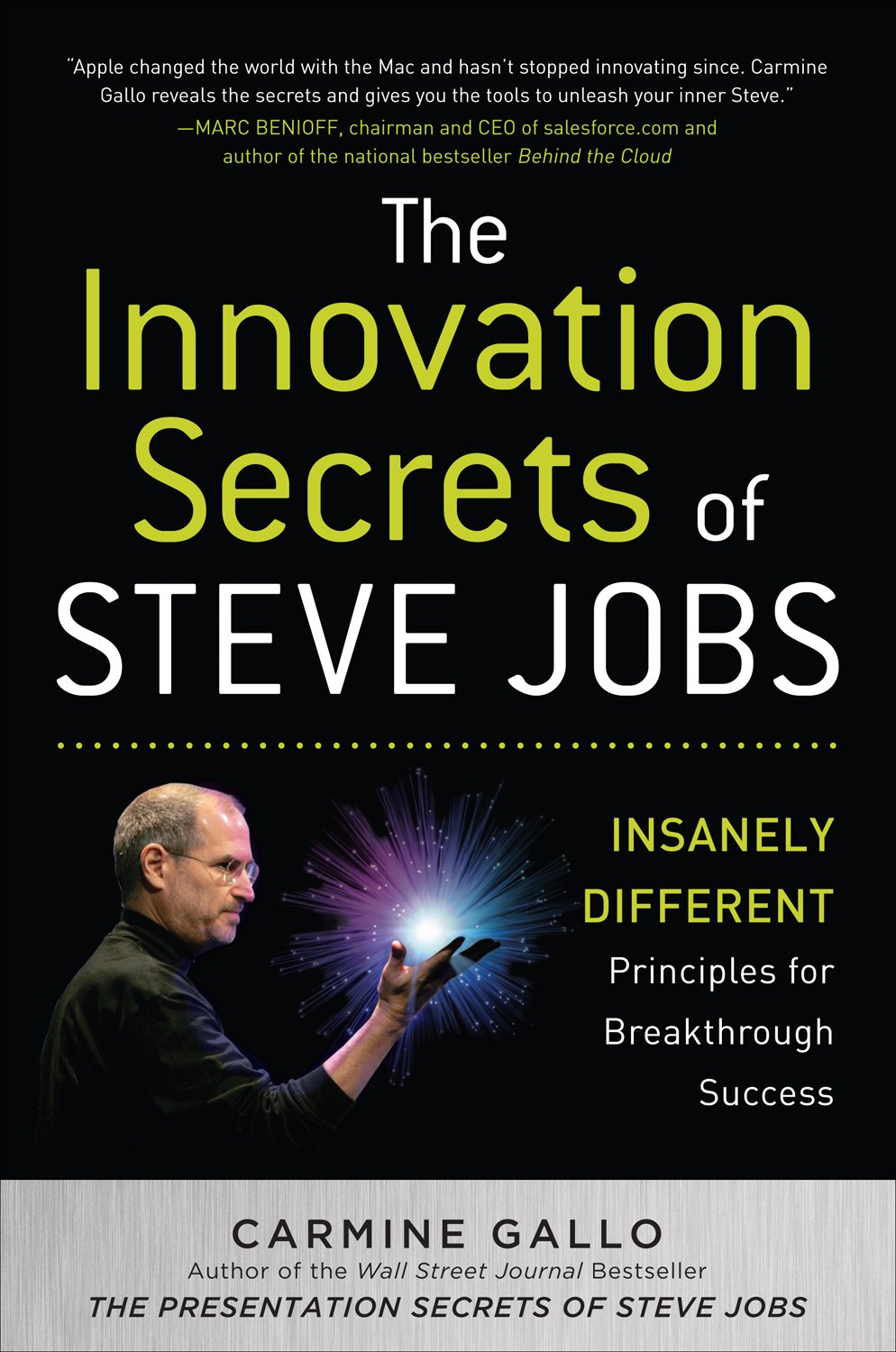
The Innovation Secrets of Steve Jobs: Insanely Different Principles for Breakthrough Success
Metadata
- Title: The Innovation Secrets of Steve Jobs: Insanely Different Principles for Breakthrough Success
- Author: Carmine Gallo
- Book URL: https://amazon.com/dp/B004477DIW?tag=malvaonlin-20
- Open in Kindle: kindle://book/?action=open&asin=B004477DIW
- Last Updated on: Monday, November 1, 2010
Highlights & Notes
“When we first started Apple we really built the first computer because we wanted one,” said Jobs. “Then we designed this crazy new computer with color and a bunch of other things called the Apple II. We had a passion to do this one simple thing which was to get a bunch of computers to our friends so they could have as much fun with them as we were.”
- pq steve jobs hizo la primer mac
» Principle 1: “Do What You Love.” Steve Jobs has followed his heart his entire life, and that, he says, has made all the difference. » Principle 2: “Put a Dent in the Universe.” Jobs attracts like-minded people who share his vision and who help turn his ideas into world-changing innovations. Passion fuels Apple’s rocket, and Jobs’s vision creates the destination. » Principle 3: “Kick-Start Your Brain.” Innovation does not exist without creativity, and for Steve Jobs, creativity is the act of connecting things. Jobs believes that a broad set of experiences broadens our understanding of the human experience. » Principle 4: “Sell Dreams, Not Products.” To Jobs, people who buy Apple products are not “consumers.” They are people with dreams, hopes, and ambitions. Jobs builds products to help them fulfill their dreams. » Principle 5: “Say No to 1,000 Things.” Simplicity is the ultimate sophistication, according to Jobs. From the designs of the iPod to the iPhone, from the packaging of Apple’s products to the functionality of the Apple website, innovation means eliminating the unnecessary so that the necessary may speak. » Principle 6: “Create Insanely Great Experiences.” Jobs has made Apple Stores the gold standard in customer service. The Apple Store has become the world’s best retailer by introducing simple innovations any business can adopt to make deep, lasting emotional connections with its customers. » Principle 7: “Master the Message.” Jobs is the world’s preeminent corporate storyteller, turning product launches into an art form. You can have the most innovative idea in the world, but if you cannot get people excited about it, your innovation doesn’t matter.
Michelangelo is quoted as saying, “The greater danger for most of us lies not in setting our aim too high and falling short, but in setting our aim too low, and achieving our mark.”
Have the courage to follow your heart and intuition. They somehow already know what you truly want to become. —STEVE JOBS
- steve rocks!
You must trust that, by following your curiosity, the pieces will ultimately fit.
I hope you’ll be as lucky as I am. The world needs inventors—great ones. You can be one. If you love what you do and are willing to do what it takes, it’s within your reach. And it’ll be worth every minute you spend alone at night, thinking and thinking about what it is you want to design or build. It’ll be worth it, I promise.7 —STEVE WOZNIAK, APPLE COFOUNDER
Your work is going to fill a large part of your life, and the only way to be truly satisfied is to do what you believe is great work. And the only way to do great work is to love what you do. If you haven’t found it yet, keep looking. Don’t settle. As with all matters of the heart, you’ll know when you find it.
Passions are irresistible. If you’re paying attention to your life at all, the things you are passionate about won’t leave you alone. They’re the ideas, hopes, and possibilities your mind naturally gravitates to, the things you would focus your time and attention on for no other reason than that doing them feels right.1
“Passion won’t protect you against setbacks, but it will ensure that no failure is ever final.”
“If you see people as assets and not liabilities, you can change the world in a profound way,”
When you are inspired by some great purpose, some extraordinary project, all your thoughts break their bonds: your mind transcends limitations, your consciousness expands in every direction, and you find yourself in a new, great, and wonderful world. Dormant forces, faculties, and talents become alive, and you discover yourself to be a greater person by far than you ever dreamed yourself the be —PATANJALI I
- proposito…
Passion isn’t enough, but when passion meets aptitude, it can indeed change the world. Steve Jobs married his passion for computers with his innate skill in electronics, design, and marketing—the ultimate combination of skills to translate the nascent personal computer market into tools for everyday people.
I was lucky to get into computers when it was a very young and idealistic industry. There weren’t many degrees offered in computer science, so people in computers were brilliant people from mathematics, physics, music, zoology, whatever. They loved it, and no one was really in it for the money.’15 —STEVE JOBS
“Your time is limited, so don’t waste it living someone else’s life,” Jobs said. “Stay hungry. Stay foolish.”
We’re gambling on our vision, and we would rather do that than make “me-too” products. For us, it’s always the next dream. —STEVE JOBS
Remember, inventions or ideas become innovations when they are turned into useful products or services that improve people’s lives.
You can dream, create, design, and build the most wonderful place in the world, but it takes people to make the dream a reality. —WALT DISNEY
passion is the fuel that gives innovators the energy to pursue their dreams, vision provides the direction that inspires evangelists to join the innovator on the journey.
In 1984, the vision would take center stage in Apple’s marketing campaign for the Macintosh with the tagline “A computer for the rest of us.” A bold vision inspires team members and turns them into evangelists for a project. And evangelists can, beyond doubt, change the world.
When people love their jobs for the work itself, they often feel committed to the organizations that make that work possible. Committed employees are likely to stay with an organization even when they are pursued by headhunters waving money. —HARVARD BUSINESS REVIEW
Innovation has nothing to do with how many R&D dollars you have. When Apple came up with the Mac, IBM was spending at least one hundred times more on R&D. It’s not about money. It’s about the people you have, how you’re led, and how much you get it. —STEVE JOBS
“There’s an old Wayne Gretzky quote that I love. ‘I skate to where the puck is going to be, not where it has been.’ We’ve always tried to do that at Apple since the very beginning.
- sports plus tech. genius!
Make no little plans; they have no magic to stir men’s blood. —DANIEL HUDSON BURNHAM, AMERICAN ARCHITECT
Big, bold visions have a way of inspiring teams. The people who worked on the Apollo program would need serious inspiration to face numerous setbacks, some quite tragic.
For innovation to happen in any field, the person with the idea must inspire others to help transform the idea into a functional product, service, or initiative.
When you’re putting people on the moon, you’re inspiring all of us to achieve the maximum of human potential, which is how our greatest problems will eventually be solved. Give yourself permission to dream. Fuel your kids’ dreams, too. — RANDY PAUSCH, THE LAST LECTURE
essence of evangelism, in Kawasaki’s view, is to passionately show people how you’re going to make history together. It has little to do with cash flow, profits, or marketing. You are selling a dream, not an object. “When you sell your product, people use it. When you evangelize people, they get infected, carry the torch for you, share your heartbeat, and defend you against your enemies. When you look in their eyes you see your logo.”6 The Macintosh way is not to sell; it’s to evangelize. You cannot evangelize without a vision.
Here’s what you find at a lot of companies. You know how you see a show car, and it’s really cool, and then four years later you see the production car, and it sucks? And you go, what happened? They had it! They had it in the palm of their hands! They grabbed defeat from the jaws of victory! What happened was, the designers came up with this really great idea. Then they take it to the engineers, and the engineers go, “Nah, we can’t do that. That’s impossible.” And so it gets a lot worse. Then they take it to the manufacturing people, and they go, “We can’t build that!”And it gets a lot worse.10 —STEVE JOBS
A vision is a picture of a better world that your product or service makes possible. Captivating visions inspire investors, employees, and customers—and best of all, they inspire those stakeholders to become evangelists for the organization. An inspiring vision meets three criteria. It’s specific, concise, and consistent. » Specific. The problem with most mission statements is that they’re too ambiguous. How many times have you heard that a particular company’s mission is to offer “best-of-breed, customer-centered solutions … blah, blah, blah”? They do not say anything meaningful. When Starbucks CEO Howard Schultz pitched investors on the original concept behind Starbucks, he painted the vision of “a third place between work and home.” Now, that’s specific. It’s tangible. You can visualize it in your mind’s eye. » Concise. When the Google guys, Sergey Brin and Larry Page, walked into the offices of Sequoia Capital, executives asked the young college students for their vision. Brin and Page responded, “To provide access to the world’s information in one click.” That one sentence was so inspiring that investors at the Silicon Valley venture firm not only funded the company but also now require any entrepreneur who steps foot into the office to articulate the company’s vision in ten words or fewer. One Sequoia investor told me, “If you can’t describe what you do in ten words or fewer, I’m not buying, I’m not investing, I’m not interested. Period.” » Consistent. A vision is meaningless if it does not have the power to persuade, and it cannot persuade if nobody knows about it! Marc Benioff, CEO of cloud computing pioneer salesforce.com, once told me that he placed his company’s vision—the end of software—on laminated cards so every employee could carry it at all times. He even had pins made with the word “Software” and a big red line through it. The vision was consistently delivered across all company channels—in presentations, on the website, in advertisements, and in all marketing material.
Creativity is just connecting things. —STEVE JOBS
Part of what made the Macintosh great was that the people working on it were musicians, and poets, and artists, and zoologists, and historians who also happened to be the best computer scientists in the world. —STEVE JOBS
“It comes down to trying to expose yourself to the best things that humans have done and then try to bring those things in to what you’re doing. Picasso had a saying. He said, ‘Good artists copy, great artists steal.’ We’ve always been shameless about stealing great ideas. Part of what made the Macintosh great was that the people working on it were musicians, and poets, and artists, and zoologists, and historians who also happened to be the best computer scientists in the world.”
The reason Apple is able to create products like the iPad is because we always try to be at the intersection of technology and liberal arts, to be able to get the best of both. —STEVE JOBS
“To see things differently than other people, the most effective solution is to bombard the brain with things it has never encountered before. Novelty releases the perceptual process from the shackles of past experiences and forces the brain to make new judgments.”9
I wish him [Bill Gates] the best, I really do. I just think he and Microsoft are a bit narrow. He’d be a broader guy if he had dropped acid once or gone off to an ashram when he was younger.’13 —STEVE JOBS
By pursuing new experiences and thinking differently about common problems, you are asking your brain to expend energy when its natural role is to conserve as much as energy as possible. It’s not easy, but by forcing yourself out of your comfort zone—physically and mentally—you will kick-start the firing of synapses, improving the odds of generating remarkable new ideas that have the potential of transforming your business and your life.
Imagination is more important than knowledge. —ALBERT EINSTEIN
“The world’s most innovative companies prosper by capitalizing on the divergent associations of their founders, executives and employees.”1
QUESTIONING
To ask effective questions, researchers suggest that you pose queries in terms of “Why,” “Why not,” and “What if.” They found that most managers are dedicated to improving the status quo a little, not blowing it up entirely. Questions that begin with “How” are more likely to lead to small improvements. The “Why” and “What if” questions lead to more explosive answers.
EXPERIMENTING
Successful innovators engage in “active” experimentation, whether it’s intellectual exploration, physical tinkering, or seeking out new surroundings.
The only way to come up with something new—something world-changing—is to think outside of the constraints everyone else has. You have to think outside of the artificial limits everyone else has already set.8 —STEVE WOZNIAK
NETWORKING
Researchers found that innovators do network, but not in the traditional sense. Instead, they surround themselves with interesting people who expand their domain of knowledge.
OBSERVING
Innovators watch people carefully, especially the behavior of potential customers. It’s during these times of observation that successful innovators seem to discover their chief breakthroughs.
We, too, are going to think differently and serve the people who have been buying our products since the beginning. Because a lot of times people think they’re crazy, but in that craziness we see genius. —STEVE JOBS
Many CEOs and frontline managers are so focused on shareholder value they forget about the consumer value, which is ultimately what makes a company profitable.”
In other words, use all the digital tools at your disposal to create new products and services (computers, websites, smartphones, advanced diagnostic equipment, etc.), but always keep in mind that the goal is the same: putting a smile on someone’s face. Maintain a commitment to excellence and an insatiable desire to upend the status quo.
iLessons 1 Commit yourself to excellence in every aspect of your business. 2 Demand excellence of others. 3 Challenge yourself and everyone on your team to make customer experience a priority.
Transformational breakthroughs are rarely the result of focus groups. Customers didn’t ask for the iTunes Store, but today they can’t live without it. Customers didn’t ask for the iPhone, but today millions of people can’t live without it. Customers didn’t ask for the iPad, but many have found that it’s a product they couldn’t imagine living without.
When you fulfill dreams, success is inevitable.
If you want to create truly innovative products or services, ask yourself, “What business am I really in?” The correct answer is not always the obvious one.
Starbucks is not in the coffee business, and that’s why it’s successful. Cranium is not in the game business; it’s in the business of selling self-esteem. Apple is not in the computer business; it’s in the business of unleashing your personal creativity. Distinguishing between products and dreams is fundamental to creating innovative products and services that change the world.
Your customers don’t care about you. It sounds harsh, but it’s true. They don’t care about the success of your company. They don’t care about your product or service. They care about themselves, their dreams, their goals.
I’m as proud of what we don’t do as I am of what we do. —STEVE JOBS
The way we approach design is by trying to achieve the most with the very least. We are absolutely consumed by trying to develop a solution that is very simple, because as physical beings we understand clarity. —JONATHAN IVE, APPLE DESIGN GURU
It sounds counterintuitive, but eliminating clutter actually makes a product stand out. The product is more elegant. And elegance is seductive. Great designers such as Ive engage our imaginations by leaving out the right things.
“Simplicity is the ultimate sophistication,” Steve Jobs told Levy in discussing the iPod’s design.14 Jobs was careful to add, however, that simplicity means much more than just removing things. Simplicity is focusing on the essential meaning of the product.
Apple does one thing very well: making complex things simple and elegant. That’s what makes Apple the world’s most innovative company.
Hans Hofmann once said, “The ability to simplify means to eliminate the unnecessary so that the necessary may speak.” By eliminating distractions, clutter, and the unnecessary, Apple allows the necessary to speak—in its products and on its website.
What makes Steve’s methodology different than everybody else’s is that he always believed that the most important decisions you make are not the things that you do, but the things you decide not to do.27 —FORMER APPLE CEO JOHN SCULLEY
Focus leads to great designs. It also leads to good business decisions. Tim Cook once commented that a traditional management philosophy taught in business schools is to reduce risk by diversifying your product offerings. Apple, he said, represents the anti–business school philosophy. Apple’s approach is to put its resources behind a few products and commit to making those products exceptionally well.
Ask yourself, How can I make my customer’s life easier, simpler, and better? Innovative companies build products or offer services that
Innovation isn’t always about adding things. It’s asking yourself, what can I take away?
Remember, an idea or an invention becomes an innovation only when it moves society forward. If an idea cannot be acted on because of its complexity, it will never meet the criteria that innovation requires.
» What are you deeply passionate about? » What are you genetically encoded for—what activities do you feel you are “made to do”? » What makes economic sense—what can you make a living at?8
“A great piece of art is composed not just of what is in the final piece, but equally important, what is not. It is the discipline to discard what does not fit that distinguishes the truly exceptional artist and marks the ideal piece of work, be it a symphony, a novel, a painting, a company, or, most important of all, a life.”
Rip a page from the Steve Jobs innovation playbook: in business, set yourself apart from your competition not by what you add but by what you remove. In life, set yourself up for success not by how many projects you choose to tackle but by how many you choose to remove. Simple, isn’t it?
People don’t want to just buy personal computers anymore. They want to know what they can do with them, and we’re going to show people exactly that. —STEVE JOBS
According to Johnson, “Innovation is this amazing intersection between someone’s imagination and the reality in which they live. The problem is, many companies don’t have great imagination, but their view of reality tells them that it’s impossible to do what they imagine.”
it’s OK to “steal” ideas from customer service experts in other industries and to adapt those ideas to your business. Stealing ideas from your competitors may work for the short term, but it’s unlikely to turn you into an innovation leader. You’re simply copying the leader. That’s not innovation. Innovation is seeing what exists in another industry and applying what you learn to improve the customer experience.
Innovation need not be expensive. But it does require a commitment to serve the customer.
You’ve baked a really lovely cake, but then you’ve used dog shit for frosting. —STEVE JOBS
Ideas are not really alive if they are confined only to a person’s mind. —NANCY DUARTE, AUTHOR, SLIDE:OLOGY
If you are the champion of a new innovation, one of your jobs is to raise the financial and human resources to get your project completed. This always means that you must convince someone—a company president, a board of directors, a venture capitalist, or a government program manager— that you have a good idea.”
This technique puts to use what psychologists call “picture superiority,” which simply means that ideas are more easily recalled when presented in both text and images rather than in text alone. This concept has profound implications for your presentations.
If you can’t describe your company, product, service, or idea in one sentence that fits within a Twitter post, go back to the drawing board. Don’t announce it until you can.
Self-confidence is the surest way of obtaining what you want. If you know in your own heart you are going to be something, you will be it. Do not permit your mind to think otherwise. It is fatal. —GENERAL GEORGE S. PATTON
Steve Jobs says he looks in the mirror every morning and asks himself, “If today were the last day of my life, would I want to do what I am about to do today?”6 If the answer is “no” for too many days in a row, Jobs knows it is time to change something. Have you been saying “no” for too long? If so, what do you think Steve would do in your situation?
In America, between the years of 1980 and 2005, virtually all net new jobs were created by firms that were five years old or less, according to New York Times columnist Thomas Friedman. Friedman proposes that for a nation to thrive, it needs more startups, not bailouts. “If we want to bring down unemployment in a sustainable way, neither rescuing General Motors nor funding more road construction will do it. We need to create a big bushel of new companies—fast … But you cannot say this often enough: Good-paying jobs don’t come from bailouts. They come from startups. And where do start-ups come from? They come from smart, creative, inspired risk takers.”7 Perhaps the ultimate lesson that Steve Jobs has taught us is that risk taking requires courage and a bit of craziness. See genius in your craziness. Believe in yourself and your vision, and be prepared to constantly defend those beliefs. Only then will innovation be allowed to flourish, and only then will you be able lead an “insanely great” life.