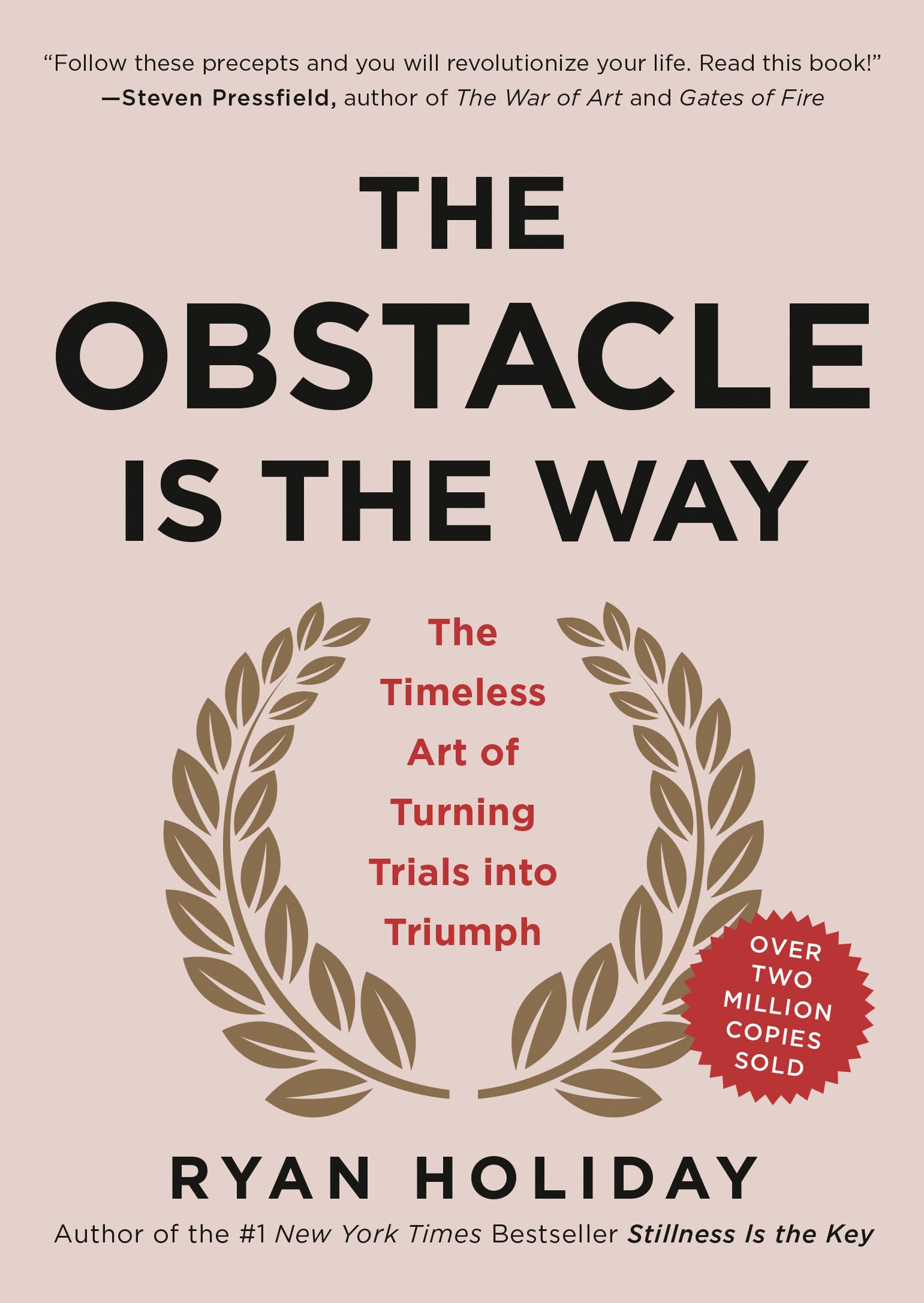
The Obstacle Is the Way: The Timeless Art of Turning Trials into Triumph
Metadata
- Title: The Obstacle Is the Way: The Timeless Art of Turning Trials into Triumph
- Author: Ryan Holiday
- Book URL: https://amazon.com/dp/B00G3L1B8K?tag=malvaonlin-20
- Open in Kindle: kindle://book/?action=open&asin=B00G3L1B8K
- Last Updated on: Monday, September 20, 2021
Highlights & Notes
Our actions may be impeded … but there can be no impeding our intentions or dispositions. Because we can accommodate and adapt. The mind adapts and converts to its own purposes the obstacle to our acting.
The impediment to action advances action. What stands in the way becomes the way.
Whatever we face, we have a choice: Will we be blocked by obstacles, or will we advance through and over them?
We might not be emperors, but the world is still constantly testing us. It asks: Are you worthy? Can you get past the things that inevitably fall in your way? Will you stand up and show us what you’re made of?
Every obstacle is unique to each of us. But the responses they elicit are the same: Fear. Frustration. Confusion. Helplessness. Depression. Anger.
We blame our bosses, the economy, our politicians, other people, or we write ourselves off as failures or our goals as impossible. When really only one thing is at fault: our attitude and approach.
“Bad companies are destroyed by crisis. Good companies survive them. Great companies are improved by them.” Great individuals, like great companies, find a way to transform weakness into strength.
Let’s be honest. Most of the time we don’t find ourselves in horrible situations we must simply endure. Rather, we face some minor disadvantage or get stuck with some less-than-favorable conditions. Or we’re trying to do something really hard and find ourselves outmatched, overstretched, or out of ideas. Well, the same logic applies. Turn it around. Find some benefit. Use it as fuel.
Not: This is not so bad. But: I can make this good. Because it can be done.
“The obstacle in the path becomes the path. Never forget, within every obstacle is an opportunity to improve our condition.”
When you have a goal, obstacles are actually teaching you how to get where you want to go—carving you a path. “The Things which hurt,” Benjamin Franklin wrote, “instruct.”
Today, most of our obstacles are internal, not external.
Instead of opposing enemies, we have internal tension. We have professional frustration. We have unmet expectations. We have learned helplessness. And we still have the same overwhelming emotions humans have always had: grief, pain, loss.
We’re soft, entitled, and scared of conflict. Great times are great softeners. Abundance can be its own obstacle, as many people can attest.
The Way Through Them Objective judgment, now at this very moment. Unselfish action, now at this very moment. Willing acceptance—now at this very moment—of all external events. That’s all you need. —MARCUS AURELIUS
Yes, because these obstacles are actually opportunities to test ourselves, to try new things, and, ultimately, to triumph. The Obstacle Is the Way.
WHAT IS PERCEPTION? It’s how we see and understand what occurs around us—and what we decide those events will mean. Our perceptions can be a source of strength or of great weakness. If we are emotional, subjective and shortsighted, we only add to our troubles.
It takes skill and discipline to bat away the pests of bad perceptions, to separate reliable signals from deceptive ones, to filter out prejudice, expectation, and fear. But it’s worth it, for what’s left is truth.
Warren Buffet’s famous adage to “be fearful when others are greedy and greedy when others are fearful.”
“Oh, how blessed young men are who have to struggle for a foundation and beginning in life,” he once said. “I shall never cease to be grateful for the three and half years of apprenticeship and the difficulties to be overcome, all along the way.”
You will come across obstacles in life—fair and unfair. And you will discover, time and time again, that what matters most is not what these obstacles are but how we see them, how we react to them, and whether we keep our composure.
Where one person sees a crisis, another can see opportunity. Where one is blinded by success, another sees reality with ruthless objectivity. Where one loses control of emotions, another can remain calm. Desperation, despair, fear, powerlessness—these reactions are functions of our perceptions. You must realize: Nothing makes us feel this way; we choose to give in to such feelings.
Outward appearances are deceptive. What’s within them, beneath them, is what matters.
We can learn to perceive things differently, to cut through the illusions that others believe or fear. We can stop seeing the “problems” in front of us as problems. We can learn to focus on what things really are.
We have a choice about how we respond to this situation (or any situation, for that matter). We can be blindly led by these primal feelings or we can understand them and learn to filter them.
We can see disaster rationally. Or rather, like Rockefeller, we can see opportunity in every disaster, and transform that negative situation into an education, a skill set, or a fortune.
There are a few things to keep in mind when faced with a seemingly insurmountable obstacle. We must try: To be objective To control emotions and keep an even keel To choose to see the good in a situation To steady our nerves To ignore what disturbs or limits others To place things in perspective To revert to the present moment To focus on what can be controlled
Choose not to be harmed—and you won’t feel harmed. Don’t feel harmed—and you haven’t been. —MARCUS AURELIUS
This can’t harm me—I might not have wanted it to happen, but I decide how it will affect me. No one else has the right.
Our perceptions are the thing that we’re in complete control of.
In fact, if we have our wits fully about us, we can step back and remember that situations, by themselves, cannot be good or bad. This is something—a judgment—that we, as human beings, bring to them with our perceptions.
“Nothing either good or bad, but thinking makes it so,” as Shakespeare put it.
through our perception of events, we are complicit in the creation—as well as the destruction—of every one of our obstacles.
There is no good or bad without us, there is only perception. There is the event itself and the story we tell ourselves about what it means.
Just because your mind tells you that something is awful or evil or unplanned or otherwise negative doesn’t mean you have to agree. Just because other people say that something is hopeless or crazy or broken to pieces doesn’t mean it is. We decide what story to tell ourselves. Or whether we will tell one at all. Welcome to the power of perception. Applicable in each and every situation, impossible to obstruct. It can only be relinquished. And that is your decision.
What such a man needs is not courage but nerve control, cool headedness. This he can get only by practice. —THEODORE ROOSEVELT
I refuse to acknowledge that. I don’t agree to be intimidated. I resist the temptation to declare this a failure.
Well, I guess it’s on me then. I don’t have the luxury of being shaken up about this or replaying close calls in my head. I’m too busy and too many people are counting on me.
There is always a countermove, always an escape or a way through, so there is no reason to get worked up. No one said it would be easy and, of course, the stakes are high, but the path is there for those ready to take it.
Would you have a great empire? Rule over yourself. —PUBLIUS SYRUS
When people panic, they make mistakes. They override systems. They disregard procedures, ignore rules. They deviate from the plan. They become unresponsive and stop thinking clearly. They just react—not to what they need to react to, but to the survival hormones that are coursing through their veins.
Life is really no different. Obstacles make us emotional, but the only way we’ll survive or overcome them is by keeping those emotions in check—if we can keep steady no matter what happens, no matter how much external events may fluctuate. The Greeks had a word for this: apatheia. It’s the kind of calm equanimity that comes with the absence of irrational or extreme emotions. Not the loss of feeling altogether, just the loss of the harmful, unhelpful kind. Don’t let the negativity in, don’t let those emotions even get started. Just say: No, thank you. I can’t afford to panic.
Does getting upset provide you with more options?
If an emotion can’t change the condition or the situation you’re dealing with, it is likely an unhelpful emotion. Or, quite possibly, a destructive one.
You can always remind yourself: I am in control, not my emotions. I see what’s really going on here. I’m not going to get excited or upset.
We defeat emotions with logic, or at least that’s the idea. Logic is questions and statements. With enough of them, we get to root causes (which are always easier to deal with). We lost money. But aren’t losses a pretty common part of business? Yes. Are these losses catastrophic? Not necessarily. So this is not totally unexpected, is it? How could that be so bad? Why are you all worked up over something that is at least occasionally supposed to happen? Well … uhh … I . .
Does what happened keep you from acting with justice, generosity, self-control, sanity, prudence, honesty, humility, straightforwardness?
Don’t let the force of an impression when it first hit you knock you off your feet; just say to it: Hold on a moment; let me see who you are and what you represent. Let me put you to the test. —EPICTETUS
The perceiving eye is weak, he wrote; the observing eye is strong.
To paraphrase Nietzsche, sometimes being superficial—taking things only at first glance—is the most profound approach.
It’s so much better to see things as they truly, actually are, not as we’ve made them in our minds.
Take your situation and pretend it is not happening to you. Pretend it is not important, that it doesn’t matter. How much easier would it be for you to know what to do? How much more quickly and dispassionately could you size up the scenario and its options? You could write it off, greet it calmly.
The more skilled you become seeing things for what they are, the more perception will work for you rather than against you.
Man does not simply exist but always decides what his existence will be, what he will become the next moment. By the same token, every human being has the freedom to change at any instant. —VIKTOR FRANKL
Perspective is everything. That is, when you can break apart something, or look at it from some new angle, it loses its power over you.
Fear is debilitating, distracting, tiring, and often irrational.
The task, as Pericles showed, is not to ignore fear but to explain it away. Take what you’re afraid of—when fear strikes you—and break it apart.
We choose how we’ll look at things. We retain the ability to inject perspective into a situation. We can’t change the obstacles themselves—that part of the equation is set—but the power of perspective can change how the obstacles appear.
The right perspective has a strange way of cutting obstacles—and adversity—down to size.
Perspective has two definitions. Context: a sense of the larger picture of the world, not just what is immediately in front of us Framing: an individual’s unique way of looking at the world, a way that interprets its events
The difference between the right and the wrong perspective is everything. How we interpret the events in our lives, our perspective, is the framework for our forthcoming response—whether there will even be one or whether we’ll just lie there and take it. Where the head goes, the body follows. Perception precedes action. Right action follows the right perspective.
In life our first job is this, to divide and distinguish things into two categories: externals I cannot control, but the choices I make with regard to them I do control. Where will I find good and bad? In me, in my choices. —EPICTETUS
- @gabrielhdm
What is up to us, what is not up to us. And what is up to us? Our emotions Our judgments Our creativity Our attitude Our perspective Our desires Our decisions Our determination This is our playing field, so to speak. Everything there is fair game. What is not up to us? Well, you know, everything else. The weather, the economy, circumstances, other people’s emotions or judgments, trends, disasters, et cetera. If what’s up to us is the playing field, then what is not up to us are the rules and conditions of the game. Factors that winning athletes make the best of and don’t spend time arguing against (because there is no point). To argue, to complain, or worse, to just give up, these are choices. Choices that more often than not, do nothing to get us across the finish line.
In its own way, the most harmful dragon we chase is the one that makes us think we can change things that are simply not ours to change. That someone decided not to fund your company, this isn’t up to you. But the decision to refine and improve your pitch? That is. That someone stole your idea or got to it first? No. To pivot, improve it, or fight for what’s yours? Yes.
Focusing exclusively on what is in our power magnifies and enhances our power. But every ounce of energy directed at things we can’t actually influence is wasted—self-indulgent and self-destructive. So much power—ours, and other people’s—is frittered away in this manner. To see an obstacle as a challenge, to make the best of it anyway, that is also a choice—a choice that is up to us.
The trick to forgetting the big picture is to look at everything close up. —CHUCK PALAHNIUK
A business must take the operating constraints of the world around it as a given and work for whatever gains are possible. Those people with an entrepreneurial spirit are like animals, blessed to have no time and no ability to think about the ways things should be, or how they’d prefer them to be.
For all species other than us humans, things just are what they are. Our problem is that we’re always trying to figure out what things mean—why things are the way they are. As though the why matters. Emerson put it best: “We cannot spend the day in explanation.” Don’t waste time on false constructs.
- @gabrielhdm
Genius is the ability to put into effect what is in your mind. There’s no other definition of it. —F. SCOTT FITZGERALD
Because though our doubts (and self-doubts) feel real, they have very little bearing on what is and isn’t possible.
Our perceptions determine, to an incredibly large degree, what we are and are not capable of. In many ways, they determine reality itself. When we believe in the obstacle more than in the goal, which will inevitably triumph?
Though of course we don’t control reality, our perceptions do influence it.
Now, how do you and I usually deal with an impossible deadline handed down from someone above us? We complain. We get angry. We question. How could they? What’s the point? Who do they think I am? We look for a way out and feel sorry for ourselves. Of course, none of these things affect the objective reality of that deadline. Not in the way that pushing forward can. Jobs refused to tolerate people who didn’t believe in their own abilities to succeed. Even if his demands were unfair, uncomfortable, or ambitious.
This is radically different from how we’ve been taught to act. Be realistic, we’re told. Listen to feedback. Play well with others. Compromise. Well, what if the “other” party is wrong? What if conventional wisdom is too conservative? It’s this all-too-common impulse to complain, defer, and then give up that holds us back.
An entrepreneur is someone with faith in their ability to make something where there was nothing before. To them, the idea that no one has ever done this or that is a good thing. When given an unfair task, some rightly see it as a chance to test what they’re made of—to give it all they’ve got, knowing full well how difficult it will be to win. They see it as an opportunity because it is often in that desperate nothing-to-lose state that we are our most creative. Our best ideas come from there, where obstacles illuminate new options.
A good person dyes events with his own color … and turns whatever happens to his own benefit. —SENECA
It’s one thing to not be overwhelmed by obstacles, or discouraged or upset by them. This is something that few are able to do. But after you have controlled your emotions, and you can see objectively and stand steadily, the next step becomes possible: a mental flip, so you’re looking not at the obstacle but at the opportunity within it.
It’s our preconceptions that are the problem. They tell us that things should or need to be a certain way, so when they’re not, we naturally assume that we are at a disadvantage or that we’d be wasting our time to pursue an alternate course. When really, it’s all fair game, and every situation is an opportunity for us to act.
The struggle against an obstacle inevitably propels the fighter to a new level of functioning. The extent of the struggle determines the extent of the growth. The obstacle is an advantage, not adversity. The enemy is any perception that prevents us from seeing this.
Then imitate the action of the tiger; stiffen the sinews, summon up the blood. —SHAKESPEARE
The demand on you is this: Once you see the world as it is, for what it is, you must act. The proper perception—objective, rational, ambitious, clean—isolates the obstacle and exposes it for what it is. A clearer head makes for steadier hands. And then those hands must be put to work. Good use.
But boldness is acting anyway, even though you understand the negative and the reality of your obstacle. Decide to tackle what stands in your way—not because you’re a gambler defying the odds but because you’ve calculated them and boldly embraced the risk.
Action is commonplace, right action is not. As a discipline, it’s not any kind of action that will do, but directed action. Everything must be done in the service of the whole. Step by step, action by action, we’ll dismantle the obstacles in front of us. With persistence and flexibility, we’ll act in the best interest of our goals. Action requires courage, not brashness—creative application and not brute force. Our movements and decisions define us: We must be sure to act with deliberation, boldness, and persistence. Those are the attributes of right and effective action. Nothing else—not thinking or evasion or aid from others. Action is the solution and the cure to our predicaments.
In life, it doesn’t matter what happens to you or where you came from. It matters what you do with what happens and what you’ve been given. And the only way you’ll do something spectacular is by using it all to your advantage.
People turn shit into sugar all the time—shit that’s a lot worse than whatever we’re dealing with. I’m talking physical disabilities, racial discrimination, battles against overwhelmingly superior armies. But those people didn’t quit. They didn’t feel sorry for themselves. They didn’t delude themselves with fantasies about easy solutions. They focused on the one thing that mattered: applying themselves with gusto and creativity.
Therefore, we can always (and only) greet our obstacles with energy with persistence with a coherent and deliberate process with iteration and resilience with pragmatism with strategic vision with craftiness and savvy and an eye for opportunity and pivotal moments Are you ready to get to work?
We must all either wear out or rust out, every one of us. My choice is to wear out. —THEODORE ROOSEVELT
While you’re sleeping, traveling, attending meetings, or messing around online, the same thing is happening to you. You’re going soft. You’re not aggressive enough. You’re not pressing ahead. You’ve got a million reasons why you can’t move at a faster pace. This all makes the obstacles in your life loom very large.
For some reason, these days we tend to downplay the importance of aggression, of taking risks, of barreling forward. It’s probably because it’s been negatively associated with certain notions of violence or masculinity.
Stay moving, always.
Just because the conditions aren’t exactly to your liking, or you don’t feel ready yet, doesn’t mean you get a pass. If you want momentum, you’ll have to create it yourself, right now, by getting up and getting started.
He says the best way out is always through And I agree to that, or in so far As I can see no way out but through. —ROBERT FROST
If we’re to overcome our obstacles, this is the message to broadcast—internally and externally. We will not be stopped by failure, we will not be rushed or distracted by external noise. We will chisel and peg away at the obstacle until it is gone. Resistance is futile.
genius often really is just persistence in disguise.
Turning over in their minds option after option, and trying each one with equal enthusiasm. Knowing that eventually—inevitably—one will work. Welcoming the opportunity to test and test and test, grateful for the priceless knowledge this reveals.
For most of what we attempt in life, chops are not the issue. We’re usually skilled and knowledgeable and capable enough. But do we have the patience to refine our idea? The energy to beat on enough doors until we find investors or supporters? The persistence to slog through the politics and drama of working with a group? Once you start attacking an obstacle, quitting is not an option. It cannot enter your head. Abandoning one path for another that might be more promising? Sure, but that’s a far cry from giving up. Once you can envision yourself quitting altogether, you might as well ring the bell. It’s done. Consider this mind-set. never in a hurry never worried never desperate never stopping short
Persist in your efforts. Resist giving in to distraction, discouragement, or disorder.
Doing new things invariably means obstacles. A new path is, by definition, uncleared. Only with persistence and time can we cut away debris and remove impediments. Only in struggling with the impediments that made others quit can we find ourselves on untrodden territory—only by persisting and resisting can we learn what others were too impatient to be taught.
It’s okay to be discouraged. It’s not okay to quit. To know you want to quit but to plant your feet and keep inching closer until you take the impenetrable fortress you’ve decided to lay siege to in your own life—that’s persistence.
When people ask where we are, what we’re doing, how that “situation” is coming along, the answer should be clear: We’re working on it. We’re getting closer. When setbacks come, we respond by working twice as hard.
What is defeat? Nothing but education; nothing but the first steps to something better. —WENDELL PHILLIPS
Failure really can be an asset if what you’re trying to do is improve, learn, or do something new.
There’s nothing shameful about being wrong, about changing course. Each time it happens we have new options. Problems become opportunities.
On the path to successful action, we will fail—possibly many times. And that’s okay. It can be a good thing, even. Action and failure are two sides of the same coin. One doesn’t come without the other. What breaks this critical connection down is when people stop acting—because they’ve taken failure the wrong way.
When failure does come, ask: What went wrong here? What can be improved? What am I missing? This helps birth alternative ways of doing what needs to be done, ways that are often much better than what we started with. Failure puts you in corners you have to think your way out of. It is a source of breakthroughs.
Great entrepreneurs are: never wedded to a position never afraid to lose a little of their investment never bitter or embarrassed never out of the game for long
Like any good school, learning from failure isn’t free. The tuition is paid in discomfort or loss and having to start over.
The one way to guarantee we don’t benefit from failure—to ensure it is a bad thing—is to not learn from it.
Failure shows us the way—by showing us what isn’t the way.
Under the comb the tangle and the straight path are the same. —HERACLITUS
Okay, you’ve got to do something very difficult. Don’t focus on that. Instead break it down into pieces. Simply do what you need to do right now. And do it well. And then move on to the next thing. Follow the process and not the prize.
And when you really get it right, even the hardest things become manageable. Because the process is relaxing. Under its influence, we needn’t panic. Even mammoth tasks become just a series of component parts.
When it comes to our actions, disorder and distraction are death. The unordered mind loses track of what’s in front of it—what matters—and gets distracted by thoughts of the future. The process is order, it keeps our perceptions in check and our actions in sync. It seems obvious, but we forget this when it matters most.
We want to have goals, yes, so everything we do can be in the service of something purposeful. When we know what we’re really setting out to do, the obstacles that arise tend to seem smaller, more manageable. When we don’t, each one looms larger and seems impossible. Goals help put the blips and bumps in proper proportion.
Go back to your stations and try to think about what we are going to do ourselves instead of worrying about what’s going on out there. You know what your job is. Stop jawing and get to work.
The process is about doing the right things, right now. Not worrying about what might happen later, or the results, or the whole picture.
Whatever is rightly done, however humble, is noble. (Quidvis recte factum quamvis humile praeclarum.) —SIR HENRY ROYCE
Wherever we are, whatever we’re doing and wherever we are going, we owe it to ourselves, to our art, to the world to do it well. That’s our primary duty. And our obligation. When action is our priority, vanity falls away.
Each project matters, and the only degrading part is giving less than one is capable of giving.
To whatever we face, our job is to respond with: hard work honesty helping others as best we can
But duty is beautiful, and inspiring and empowering.
In every situation, life is asking us a question, and our actions are the answer.
Right action—unselfish, dedicated, masterful, creative—that is the answer to that question. That’s one way to find the meaning of life. And how to turn every obstacle into an opportunity.
How you do anything is how you can do everything. We can always act right.
The cucumber is bitter? Then throw it out. There are brambles in the path? Then go around. That’s all you need to know. —MARCUS AURELIUS
Forget the rule book, settle the issue. This is pragmatism embodied. Don’t worry about the “right” way, worry about the right way. This is how we get things done.
Sometimes you do it this way. Sometimes that way. Not deploying the tactics you learned in school but adapting them to fit each and every situation. Any way that works—that’s the motto.
You’ve got your mission, whatever it is. To accomplish it, like the rest of us you’re in the pinch between the way you wish things were and the way they actually are (which always seem to be a disaster). How far are you willing to go? What are you willing to do about it?
With the stakes this high, you better be willing to bend the rules or do something desperate or crazy. To thumb your nose at the authorities and say: What? This is not a bridge. I don’t know what you’re talking about. Or, in some cases, giving the middle finger to the people trying to hold you down and blowing right through their evil, disgusting rules.
But so many of us spend so much time looking for the perfect solution that we pass up what’s right in front of us.
The Stoics had their own reminder: “Don’t go expecting Plato’s Republic.” Because you’re never going to find that kind of perfection. Instead, do the best with what you’ve got. Not that pragmatism is inherently at odds with idealism or pushing the ball forward. The first iPhone was revolutionary, but it still shipped without a copy-and-paste feature or a handful of other features Apple would have liked to have included. Steve Jobs, the supposed perfectionist, knew that at some point, you have to compromise. What mattered was that you got it done and it worked.
Start thinking like a radical pragmatist: still ambitious, aggressive, and rooted in ideals, but also imminently practical and guided by the possible. Not on everything you would like to have, not on changing the world right at this moment, but ambitious enough to get everything you need. Don’t think small, but make the distinction between the critical and the extra. Think progress, not perfection.
Whoever cannot seek the unforeseen sees nothing, for the known way is an impasse. —HERACLITUS
What’s your first instinct when faced with a challenge? Is it to outspend the competition? Argue with people in an attempt to change long-held opinions? Are you trying to barge through the front door? Because the back door, side doors, and windows may have been left wide open.
Being outnumbered, coming from behind, being low on funds, these don’t have to be disadvantages. They can be gifts. Assets that make us less likely to commit suicide with a head-to-head attack. These things force us to be creative, to find workarounds, to sublimate the ego and do anything to win besides challenging our enemies where they are strongest. These are the signs that tell us to approach from an oblique angle.
We’re in the game of little defeating big. Therefore, Force can’t try to match Force. Of course, when pushed, the natural instinct is always to push back. But martial arts teach us that we have to ignore this impulse. We can’t push back, we have to pull until opponents lose their balance. Then we make our move. The art of the side-door strategy is a vast, creative space. And it is by no means limited to war, business, or sales.
Remember, sometimes the longest way around is the shortest way home.
Wise men are able to make a fitting use even of their enmities. —PLUTARCH
Sometimes you overcome obstacles not by attacking them but by withdrawing and letting them attack you. You can use the actions of others against themselves instead of acting yourself.
Opposites work. Nonaction can be action. It uses the power of others and allows us to absorb their power as our own. Letting them—or the obstacle—do the work for us.
So instead of fighting obstacles, find a means of making them defeat themselves.
Sometimes in your life you need to have patience—wait for temporary obstacles to fizzle out. Let two jousting egos sort themselves out instead of jumping immediately into the fray. Sometimes a problem needs less of you—fewer people period—and not more.
We wrongly assume that moving forward is the only way to progress, the only way we can win. Sometimes, staying put, going sideways, or moving backward is actually the best way to eliminate what blocks or impedes your path.
And let’s be clear, using obstacles against themselves is very different from doing nothing. Passive resistance is, in fact, incredibly active. But those actions come in the form of discipline, self-control, fearlessness, determination, and grand strategy.
Remember, a castle can be an intimidating, impenetrable fortress, or it can be turned into a prison when surrounded. The difference is simply a shift in action and approach.
We can use the things that block us to our advantage, letting them do the difficult work for us. Sometimes this means leaving the obstacle as is, instead of trying so hard to change it.
When jarred, unavoidably, by circumstance revert at once to yourself and don’t lose the rhythm more than you can help. You’ll have a better grasp of harmony if you keep going back to it. —MARCUS AURELIUS
Adversity can harden you. Or it can loosen you up and make you better—if you let it.
But think of an athlete “in the pocket,” “in the zone,” “on a streak,” and the seemingly insurmountable obstacles that fall in the face of that effortless state. Enormous deficits collapse, every pass or shot hits its intended target, fatigue melts away. Those athletes might be stopped from carrying out this or that action, but not from their goal. External factors influence the path, but not the direction: forward.
To be physically and mentally loose takes no talent. That’s just recklessness. (We want right action, not action period.) To be physically and mentally tight? That’s called anxiety. It doesn’t work, either. Eventually we snap. But physical looseness combined with mental restraint? That is powerful. It’s a power that drives our opponents and competitors nuts. They think we’re toying with them. It’s maddening—like we aren’t even trying, like we’ve tuned out the world. Like we’re immune to external stressors and limitations on the march toward our goals. Because we are.
The best men are not those who have waited for chances but who have taken them; besieged chance, conquered the chance, and made chance the servitor. —E. H. CHAPIN
It’s at the seemingly bad moments, when people least expect it, that we can act swiftly and unexpectedly to pull off a big victory. While others are arrested by discouragement, we are not. We see the moment differently, and act accordingly.
“You never want a serious crisis to go to waste. Things that we had postponed for too long, that were long-term, are now immediate and must be dealt with. [A] crisis provides the opportunity for us to do things that you could not do before.”
business. Approach a possible mentor. Launch a movement. Well, now something has happened—some disruptive event like a failure or an accident or a tragedy. Use it. Perhaps you’re stuck in bed recovering. Well, now you have time to write. Perhaps your emotions are overwhelming and painful, turn it into material. You lost your job or a relationship? That’s awful, but now you can travel unencumbered. You’re having a problem? Now you know exactly what to approach that mentor about. Seize this moment to deploy the plan that has long sat dormant in your head. Every chemical reaction requires a catalyst. Let this be yours.
Ordinary people shy away from negative situations, just as they do with failure. They do their best to avoid trouble. What great people do is the opposite. They are their best in these situations. They turn personal tragedy or misfortune—really anything, everything—to their advantage.
hopelessly deadlocked—they press once more. In many battles, as in life, the two opposing forces will often reach a point of mutual exhaustion. It’s the one who rises the next morning after a long day of fighting and rallies, instead of retreating—the one who says, I intend to attack and whip them right here and now—who will carry victory home … intelligently.
In the meantime, cling tooth and nail to the following rule: not to give in to adversity, not to trust prosperity, and always take full note of fortune’s habit of behaving just as she pleases. —SENECA
Perceptions can be managed. Actions can be directed. We can always think clearly, respond creatively. Look for opportunity, seize the initiative. What we can’t do is control the world around us—not as much as we’d like to, anyway. We might perceive things well, then act rightly, and fail anyway. Run it through your head like this: Nothing can ever prevent us from trying. Ever.
Problems, as Duke Ellington once said, are a chance for us to do our best. Just our best, that’s it. Not the impossible.
Anyone in pursuit of a goal comes face-to-face with this time and time again. Sometimes, no amount of planning, no amount of thinking—no matter how hard we try or patiently we persist—will change the fact that some things just aren’t going to work. The world could use fewer martyrs.
WHAT IS WILL? Will is our internal power, which can never be affected by the outside world. It is our final trump card. If action is what we do when we still have some agency over our situation, the will is what we depend on when agency has all but disappeared.
If Perception and Action were the disciplines of the mind and the body, then Will is the discipline of the heart and the soul.
The will is the one thing we control completely, always. Whereas I can try to mitigate harmful perceptions and give 100 percent of my energy to actions, those attempts can be thwarted or inhibited. My will is different, because it is within me.
This, too, is part of the will—to think of others, to make the best of a terrible situation that we tried to prevent but could not, to deal with fate with cheerfulness and compassion.
Certain things in life will cut you open like a knife. When that happens—at that exposing moment—the world gets a glimpse of what’s truly inside you. So what will be revealed when you’re sliced open by tension and pressure? Iron? Or air? Or bullshit?
It’s much easier to control our perceptions and emotions than it is to give up our desire to control other people and events. It’s easier to persist in our efforts and actions than to endure the uncomfortable or the painful. It’s easier to think and act than it is to practice wisdom.
If thy faint in the day of adversity, thy strength is small. —PROVERBS 24:10
We take weakness for granted. We assume that the way we’re born is the way we simply are, that our disadvantages are permanent. And then we atrophy from there.
Not everyone accepts their bad start in life. They remake their bodies and their lives with activities and exercise. They prepare themselves for the hard road. Do they hope they never have to walk it? Sure. But they are prepared for it in any case.
Nobody is born with a steel backbone. We have to forge that ourselves. We craft our spiritual strength through physical exercise, and our physical hardiness through mental practice (mens sana in corpore sano—sound mind in a strong body).
This is strikingly similar to what the Stoics called the Inner Citadel, that fortress inside of us that no external adversity can ever break down. An important caveat is that we are not born with such a structure; it must be built and actively reinforced. During the good times, we strengthen ourselves and our bodies so that during the difficult times, we can depend on it. We protect our inner fortress so it may protect us.
You’ll have far better luck toughening yourself up than you ever will trying to take the teeth out of a world that is—at best—indifferent to your existence.
No one is born a gladiator. No one is born with an Inner Citadel. If we’re going to succeed in achieving our goals despite the obstacles that may come, this strength in will must be built.
To be great at something takes practice. Obstacles and adversity are no different. Though it would be easier to sit back and enjoy a cushy modern life, the upside of preparation is that we’re not disposed to lose all of it—least of all our heads—when someone or something suddenly messes with our plans.
The path of least resistance is a terrible teacher. We can’t afford to shy away from the things that intimidate us. We don’t need to take our weaknesses for granted.
Offer a guarantee and disaster threatens. —ANCIENT INSCRIPTION AT THE ORACLE OF DELPHI
A premortem is different. In it, we look to envision what could go wrong, what will go wrong, in advance, before we start. Far too many ambitious undertakings fail for preventable reasons.
Far too many people don’t have a backup plan because they refuse to consider that something might not go exactly as they wish.
Your plan and the way things turn out rarely resemble each other. What you think you deserve is also rarely what you’ll get. Yet we constantly deny this fact and are repeatedly shocked by the events of the world as they unfold.
They even had a better name: premeditatio malorum (premeditation of evils).
“Nothing happens to the wise man against his expectation,” he wrote to a friend. “… nor do all things turn out for him as he wished but as he reckoned—and above all he reckoned that something could block his plans.”
What if … Then I will … What if … Instead I’ll just … What if … No problem, we can always …
Your world is ruled by external factors. Promises aren’t kept. You don’t always get what is rightfully yours, even if you earned it. Not everything is as clean and straightforward as the games they play in business school. Be prepared for this.
The only guarantee, ever, is that things will go wrong. The only thing we can use to mitigate this is anticipation. Because the only variable we control completely is ourselves.
Anticipation doesn’t magically make things easier, of course. But we are prepared for them to be as hard as they need to be, as hard as they actually are.
You know you want to accomplish X, so you invest time, money, and relationships into achieving it. About the worst thing that can happen is not something going wrong, but something going wrong and catching you by surprise. Why? Because unexpected failure is discouraging and being beaten back hurts.
You know what’s better than building things up in your imagination? Building things up in real life. Of course, it’s a lot more fun to build things up in your imagination than it is to tear them down. But what purpose does that serve? It only sets you up for disappointment. Chimeras are like bandages—they hurt only when torn away.
The Fates guide the person who accepts them and hinder the person who resists them. —CLEANTHES
It doesn’t always feel that way but constraints in life are a good thing. Especially if we can accept them and let them direct us. They push us to places and to develop skills that we’d otherwise never have pursued. Would we rather have everything? Sure, but that isn’t up to us.
After you’ve distinguished between the things that are up to you and the things that aren’t (ta eph’hemin, ta ouk eph’hemin), and the break comes down to something you don’t control … you’ve got only one option: acceptance.
You don’t have to like something to master it—or to use it to some advantage. When the cause of our problem lies outside of us, we are better for accepting it and moving on. For ceasing to kick and fight against it, and coming to terms with it. The Stoics have a beautiful name for this attitude. They call it the Art of Acquiescence. Let’s be clear, that is not the same thing as giving up. This has nothing to do with action—this is for the things that are immune to action. It is far easier to talk of the way things should be. It takes toughness, humility, and will to accept them for what they actually are. It takes a real man or woman to face necessity.
Lose money? Remember, you could have lost a friend. Lost that job? What if you’d lost a limb? Lost your house? You could have lost everything.
The way life is gives you plenty to work with, plenty to leave your imprint on. Taking people and events as they are is quite enough material already. Follow where the events take you, like water rolling down a hill—it always gets to the bottom eventually, doesn’t it? Because (a) you’re robust and resilient enough to handle whatever occurs, (b) you can’t do anything about it anyway, and (c) you’re looking at a big-enough picture and long-enough time line that whatever you have to accept is still only a negligible blip on the way to your goal. We’re indifferent and that’s not a weakness.
My formula for greatness in a human being is amor fati: that one wants nothing to be different, not forward, not backward, not in all eternity. Not merely bear what is necessary, still less conceal it … but love it. —NIETZSCHE
To do great things, we need to be able to endure tragedy and setbacks. We’ve got to love what we do and all that it entails, good and bad. We have to learn to find joy in every single thing that happens.
The next step after we discard our expectations and accept what happens to us, after understanding that certain things—particularly bad things—are outside our control, is this: loving whatever happens to us and facing it with unfailing cheerfulness.
It is the act of turning what we must do into what we get to do.
As the Stoics commanded themselves: Cheerfulness in all situations, especially the bad ones.
The goal is: Not: I’m okay with this. Not: I think I feel good about this. But: I feel great about it. Because if it happened, then it was meant to happen, and I am glad that it did when it did. I am meant to make the best of it.
We don’t get to choose what happens to us, but we can always choose how we feel about it. And why on earth would you choose to feel anything but good? We can choose to render a good account of ourselves. If the event must occur, Amor fati (a love of fate) is the response.
“Gentleman, I am hardening on this enterprise. I repeat, I am now hardening towards this enterprise.” —WINSTON CHURCHILL
If persistence is attempting to solve some difficult problem with dogged determination and hammering until the break occurs, then plenty of people can be said to be persistent. But perseverance is something larger. It’s the long game. It’s about what happens not just in round one but in round two and every round after—and then the fight after that and the fight after that, until the end.
Persistence is an action. Perseverance is a matter of will. One is energy. The other, endurance.
There are far more failures in the world due to a collapse of will than there will ever be from objectively conclusive external events.
Our actions can be constrained, but our will can’t be. Our plans—even our bodies—can be broken. But belief in ourselves? No matter how many times we are thrown back, we alone retain the power to decide to go once more. Or to try another route. Or, at the very least, to accept this reality and decide upon a new aim.
The true threat to determination, then, is not what happens to us, but us ourselves. Why would you be your own worst enemy? Hold on and hold steady.
A man’s job is to make the world a better place to live in, so far as he is able—always remembering the results will be infinitesimal—and to attend to his own soul. —LEROY PERCY
Not that you need to martyr yourself. See, when we focus on others, on helping them or simply providing a good example, our own personal fears and troubles will diminish. With fear or heartache no longer our primary concern, we don’t have time for it. Shared purpose gives us strength.
If I can’t solve this for myself, how can I at least make this better for other people?
Start thinking: Unity over Self. We’re in this together.
Pride can be broken. Toughness has its limits. But a desire to help? No harshness, no deprivation, no toil should interfere with our empathy toward others. Compassion is always an option. Camaraderie as well. That’s a power of the will that can never be taken away, only relinquished.
Embrace this power, this sense of being part of a larger whole. It is an exhilarating thought. Let it envelop you. We’re all just humans, doing the best we can. We’re all just trying to survive, and in the process, inch the world forward a little bit.
Help your fellow humans thrive and survive, contribute your little bit to the universe before it swallows you up, and be happy with that. Lend a hand to others. Be strong for them, and it will make you stronger.
When a man knows he is to be hanged in a fortnight, it concentrates his mind wonderfully. —DR. JOHNSON
Death doesn’t make life pointless, but rather purposeful. And, fortunately, we don’t have to nearly die to tap into this energy.
Our fear of death is a looming obstacle in our lives. It shapes our decisions, our outlook, and our actions.
Part of the reason we have so much trouble with acceptance is because our relationship with our own existence is totally messed up. We may not say it, but deep down we act and behave like we’re invincible. Like we’re impervious to the trials and tribulations of mortality. That stuff happens to other people, not to ME. I have plenty of time left.
It’s a cliché question to ask, What would I change about my life if the doctor told me I had cancer? After our answer, we inevitably comfort ourselves with the same insidious lie: Well, thank God I don’t have cancer.
The diagnosis is terminal for all of us. A death sentence has been decreed. Each second, probability is eating away at the chances that we’ll be alive tomorrow; something is coming and you’ll never be able to stop it. Be ready for when that day comes.
Reminding ourselves each day that we will die helps us treat our time as a gift. Someone on a deadline doesn’t indulge himself with attempts at the impossible, he doesn’t waste time complaining about how he’d like things to be.
Of course, I would have liked to last a little longer, but I made a lot of out what I was already given so this works too.
But that is not to say it is not without value to us while we are alive. In the shadow of death, prioritization is easier. As are graciousness and appreciation and principles. Everything falls in its proper place and perspective. Why would you do the wrong thing? Why feel fear? Why let yourself and others down? Life will be over soon enough; death chides us that we may as well do life right.
Live on in your blessings, your destiny’s been won. But ours calls us on from one ordeal to the next. —VIRGIL
The great law of nature is that it never stops. There is no end. Just when you think you’ve successfully navigated one obstacle, another emerges. But that’s what keeps life interesting. And as you’re starting to see, that’s what creates opportunities. Life is a process of breaking through these impediments—a series of fortified lines that we must break through. Each time, you’ll learn something. Each time, you’ll develop strength, wisdom, and perspective. Each time, a little more of the competition falls away. Until all that is left is you: the best version of you.
Knowing that life is a marathon and not a sprint is important. Conserve your energy. Understand that each battle is only one of many and that you can use it to make the next one easier. More important, you must keep them all in real perspective. Passing one obstacle simply says you’re worthy of more. The world seems to keep throwing them at you once it knows you can take it. Which is good, because we get better with every attempt. Never rattled. Never frantic. Always hustling and acting with creativity. Never anything but deliberate. Never attempting to do the impossible—but everything up to that line. Simply flipping the obstacles that life throws at you by improving in spite of them, because of them. And therefore no longer afraid. But excited, cheerful, and eagerly anticipating the next round.
First, see clearly. Next, act correctly. Finally, endure and accept the world as it is.
Perceive things as they are, leave no option unexplored, then stand strong and transform whatever can’t be changed. And they all feed into one another: Our actions give us the confidence to ignore or control our perceptions. We prove and support our will with our actions.
The philosopher and writer Nassim Nicholas Taleb defined a Stoic as someone who “transforms fear into prudence, pain into transformation, mistakes into initiation and desire into undertaking.”
See things for what they are. Do what we can. Endure and bear what we must. What blocked the path now is a path. What once impeded action advances action. The Obstacle is the Way.
To be a philosopher is not merely to have subtle thoughts, nor even to found a school … it is to solve some of the problems of life, not only theoretically, but practically. —HENRY DAVID THOREAU
They deprived us of philosophy’s true use: as an operating system for the difficulties and hardships of life.