The Prince (Annotated with Summary/Study Guide)
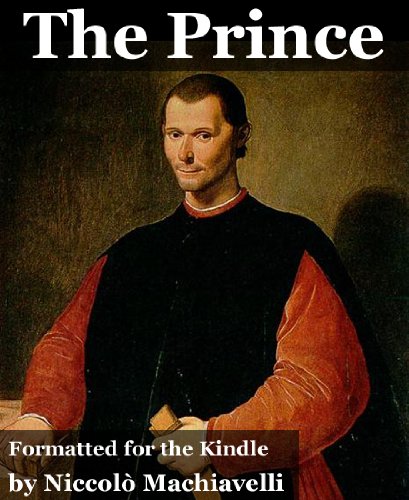
Metadata
- Title: The Prince (Annotated with Summary/Study Guide)
- Author: Nicolo Machiavelli, Superior Formatting Publishing, and W. K. Marriott
- Book URL: https://amazon.com/dp/B003X976CA?tag=malvaonlin-20
- Open in Kindle: kindle://book/?action=open&asin=B003X976CA
- Last Updated on: Friday, June 19, 2015
Highlights & Notes
Nicolo Machiavelli was born at Florence on 3rd May 1469. He was the second son of Bernardo di Nicolo Machiavelli, a lawyer of some repute, and of Bartolommea di Stefano Nelli, his wife. Both parents were members of the old Florentine nobility.
it is far better to earn the confidence of the people than to rely on fortresses.
Machiavelli moralizes on the resemblance between Fortune and women, and concludes that it is the bold rather than the cautious man that will win and hold them both.
“The evening being come, I return home and go to my study; at the entrance I pull off my peasant-clothes, covered with dust and dirt, and put on my noble court dress, and thus becomingly re-clothed I pass into the ancient courts of the men of old, where, being lovingly received by them, I am fed with that food which is mine alone; where I do not hesitate to speak with them, and to ask for the reason of their actions, and they in their benignity answer me; and for four hours I feel no weariness, I forget every trouble, poverty does not dismay, death does not terrify me; I am possessed entirely by those great men. And because Dante says: Knowledge doth come of learning well retained, Unfruitful else, I have noted down what I have gained from their conversation, and have composed a small work on ‘Principalities,’ where I pour myself out as fully as I can in meditation on the subject, discussing what a principality is, what kinds there are, how they can be acquired, how they can be kept, why they are lost: and if any of my fancies ever pleased you, this ought not to displease you: and to a prince, especially to a new one, it should be welcome: therefore I dedicate it to his Magnificence Giuliano. Filippo Casavecchio has seen it; he will be able to tell you what is in it, and of the discourses I have had with him; nevertheless, I am still enriching and polishing it.”
Men will not look at things as they really are, but as they wish them to be—and are ruined. In politics there are no perfectly safe courses; prudence consists in choosing the least dangerous ones. Then—to pass to a higher plane—Machiavelli reiterates that, although crimes may win an empire, they do not win glory. Necessary wars are just wars, and the arms of a nation are hallowed when it has no other resource but to fight.
I will leave out all discussion on republics, inasmuch as in another place I have written of them at length, and will address myself only to principalities.
In this way you have enemies in all those whom you have injured in seizing that principality, and you are not able to keep those friends who put you there because of your not being able to satisfy them in the way they expected, and you cannot take strong measures against them, feeling bound to them. For, although one may be very strong in armed forces, yet in entering a province one has always need of the goodwill of the natives.
Because, if one is on the spot, disorders are seen as they spring up, and one can quickly remedy them; but if one is not at hand, they are heard of only when they are great, and then one can no longer remedy them.
Upon this, one has to remark that men ought either to be well treated or crushed, because they can avenge themselves of lighter injuries, of more serious ones they cannot; therefore the injury that is to be done to a man ought to be of such a kind that one does not stand in fear of revenge.
when foreseen, it is easy to remedy them; but if you wait until they approach, the medicine is no longer in time because the malady has become incurable; for it happens in this, as the physicians say it happens in hectic fever, that in the beginning of the malady it is easy to cure but difficult to detect, but in the course of time, not having been either detected or treated in the beginning, it becomes easy to detect but difficult to cure.
This it happens in affairs of state, for when the evils that arise have been foreseen (which it is only given to a wise man to see), they can be quickly redressed, but when, through not having been foreseen, they have been permitted to grow in a way that every one can see them, there is no longer a remedy.
The wish to acquire is in truth very natural and common, and men always do so when they can, and for this they will be praised not blamed; but when they cannot do so, yet wish to do so by any means, then there is folly and blame.
From this a general rule is drawn which never or rarely fails: that he who is the cause of another becoming powerful is ruined; because that predominancy has been brought about either by astuteness or else by force, and both are distrusted by him who has been raised to power.
And in examining their actions and lives one cannot see that they owed anything to fortune beyond opportunity, which brought them the material to mould into the form which seemed best to them. Without that opportunity their powers of mind would have been extinguished, and without those powers the opportunity would have come in vain.
And it ought to be remembered that there is nothing more difficult to take in hand, more perilous to conduct, or more uncertain in its success, than to take the lead in the introduction of a new order of things, because
the innovator has for enemies all those who have done well under the old conditions, and lukewarm defenders in those who may do well under the new.
Hence it is that all armed prophets have conquered, and the unarmed ones have been destroyed.
States that rise unexpectedly, then, like all other things in nature which are born and grow rapidly, cannot leave their foundations and correspondencies(*) fixed in such a way that the first storm will not overthrow them; unless,
rule of weak masters, who rather plundered their subjects than ruled them, and gave them more cause for disunion than for union, so that the country was full of robbery, quarrels, and every kind of violence; and so, wishing to bring back peace and obedience to authority, he considered it necessary to give it a good governor. Thereupon he promoted Messer Ramiro d’Orco,(*) a swift and cruel man, to whom he gave the fullest power. This man in a short time restored peace and unity with the greatest success. Afterwards the duke considered that it was not advisable to confer such excessive authority, for he had no doubt but that he would become odious, so he set up a court of judgment in the country, under a most excellent president, wherein all cities had their advocates. And because he knew that the past severity had caused some hatred against himself, so, to clear himself in the minds of the people, and gain them entirely to himself, he desired to show that, if any cruelty had been practised, it had not originated with him, but in the natural sternness of the minister. Under this pretence he took Ramiro, and one morning caused him to be executed and left on the piazza at Cesena with the block and a bloody knife at his side. The barbarity of this spectacle caused the people to be at once satisfied and dismayed.
For men injure either from fear or hatred.
He who believes that new benefits will cause great personages to forget old injuries is deceived.
Yet it cannot be called talent to slay fellow-citizens, to deceive friends, to be without faith, without mercy, without religion; such methods may gain empire, but not glory.
I believe that this follows from severities(*) being badly or properly used. Those may be called properly used, if of evil it is possible to speak well, that are applied at one blow and are necessary to one’s security, and that are not persisted in afterwards unless they can be turned to the advantage of the subjects. The badly employed are those which, notwithstanding they may be few in the commencement, multiply with time rather than decrease.
For injuries ought to be done all at one time, so that, being tasted less, they offend less; benefits ought to be given little by little, so that the flavour of them may last longer.
For such a prince cannot rely upon what he observes in quiet times, when citizens have need of the state, because then every one agrees with him; they all promise, and when death is far distant they all wish to die for him; but in troubled times, when the state has need of its citizens, then he finds but few.
It only remains now to speak of ecclesiastical principalities, touching which all difficulties are prior to getting possession, because they are acquired either by capacity or good fortune, and they can be held without either; for they are sustained by the ancient ordinances of religion, which are so all-powerful, and of such a character that the principalities may be held no matter how their princes behave and live.
Such principalities only are secure and happy. But being upheld by powers, to which the human mind cannot reach, I shall speak no more of them, because, being exalted and maintained by God, it would be the act of a presumptuous and rash man to discuss them.
I say, therefore, that the arms with which a prince defends his state are either his own, or they are mercenaries, auxiliaries, or mixed. Mercenaries and auxiliaries are useless and dangerous; and if one holds his state based on these arms, he will stand neither firm nor safe; for they are disunited, ambitious, and without discipline, unfaithful, valiant before friends, cowardly before enemies; they have neither the fear of God nor fidelity to men, and destruction is deferred only so long as the attack is; for in peace one is robbed by them, and in war by the enemy. The fact is, they have no other attraction or reason for keeping the field than a trifle of stipend, which is not sufficient to make them willing to die for you.
Therefore, if he who rules a principality cannot recognize evils until they are upon him, he is not truly wise; and this insight is given to few.
And it has always been the opinion and judgment of wise men that nothing can be so uncertain or unstable as fame or power not founded on its own strength.
He ought never, therefore, to have out of his thoughts this subject of war, and in peace he should addict himself more to its exercise than in war; this he can do in two ways, the one by action, the other by study.
But to exercise the intellect the prince should read histories, and study there the actions of illustrious men, to see how they have borne themselves in war, to examine the causes of their victories and defeat, so as to avoid the latter and imitate the former; and above all do as an illustrious man did, who took as an exemplar one who had been praised and famous before him, and whose achievements and deeds he always kept in his mind, as it is said Alexander the Great imitated Achilles, Caesar Alexander, Scipio Cyrus.
A wise prince ought to observe some such rules, and never in peaceful times stand idle, but increase his resources with industry in such a way that they may be available to him in adversity, so that if fortune chances it may find him prepared to resist her blows.
because how one lives is so far distant from how one ought to live, that he who neglects what is done for what ought to be done, sooner effects his ruin than his preservation;
Hence it is necessary for a prince wishing to hold his own to know how to do wrong, and to make use of it or not according to necessity.
We have not seen great things done in our time except by those who have been considered mean; the rest have failed.
- muy actual
Cesare Borgia was considered cruel; notwithstanding, his cruelty reconciled the Romagna, unified it, and restored it to peace and loyalty. And if this be rightly considered, he will be seen to have been much more merciful than the Florentine people, who, to avoid a reputation for cruelty, permitted Pistoia to be destroyed.(*)
Upon this a question arises: whether it be better to be loved than feared or feared than loved? It may be answered that one should wish to be both, but, because it is difficult to unite them in one person, it is much safer to be feared than loved, when, of the two, either must be dispensed with.
men more quickly forget the death of their father than the loss of their patrimony.
And short-sighted writers admire his deeds from one point of view and from another condemn the principal cause of them.
A prince, therefore, being compelled knowingly to adopt the beast, ought to choose the fox and the lion; because the lion cannot defend himself against snares and the fox cannot defend himself against wolves. Therefore, it is necessary to be a fox to discover the snares and a lion to terrify the wolves. Those who rely simply on the lion do not understand what they are about.
and men are so simple, and so subject to present necessities, that he who seeks to deceive will always find someone who will allow himself to be deceived.
Therefore it is necessary for him to have a mind ready to turn itself accordingly as the winds and variations of fortune force it, yet, as I have said above, not to diverge from the good if he can avoid doing so, but, if compelled, then to know how to set about it.
Every one sees what you appear to be, few really know what you are, and those few dare not oppose themselves to the opinion of the many, who have the majesty of the state to defend them; and in the actions of all men, and especially of princes, which it is not prudent to challenge, one judges by the result.
It makes him hated above all things, as I have said, to be rapacious, and to be a violator of the property and women of his subjects, from both of which he must abstain. And when neither their property nor their honor is touched, the majority of men live content, and he has only to contend with the ambition of a few, whom he can curb with ease in many ways.
For this reason I consider that a prince ought to reckon conspiracies of little account when his people hold him in esteem; but when it is hostile to him, and bears hatred towards him, he ought to fear everything and everybody.
- Our forefathers, and those who were reckoned wise, were accustomed to say that it was necessary to hold Pistoia by factions and Pisa by fortresses; and with this idea they fostered quarrels in some of their tributary towns so as to keep possession of them the more easily. This may have been well enough in those times when Italy was in a way balanced, but I do not believe that it can be accepted as a precept for to-day, because I do not believe that factions can ever be of use; rather it is certain that when the enemy comes upon you in divided cities you are quickly lost, because the weakest party will always assist the outside forces and the other will not be able to resist.
But on this question one cannot speak generally, for it varies so much with the individual;
Fortresses, therefore, are useful or not according to circumstances; if they do you good in one way they injure you in another. And this question can be reasoned thus: the prince who has more to fear from the people than from foreigners ought to build fortresses, but he who has more to fear from foreigners than from the people ought to leave them alone.
For this reason the best possible fortress is—not to be hated by the people, because, although you may hold the fortresses, yet they will not save you if the people hate you, for there will never be wanting foreigners to assist a people who have taken arms against you.
I shall praise him who builds fortresses as well as him who does not, and I shall blame whoever, trusting in them, cares little about being hated by the people.
Nothing makes a prince so much esteemed as great enterprises and setting a fine example.
And a prince ought, above all things, always endeavour in every action to gain for himself the reputation of being a great and remarkable man.
A prince is also respected when he is either a true friend or a downright enemy, that is to say, when, without any reservation, he declares himself in favour of one party against the other; which course will always be more advantageous than standing neutral;
And irresolute princes, to avoid present dangers, generally follow the neutral path, and are generally ruined. But when a prince declares himself gallantly in favour of one side, if the party with whom he allies himself conquers, although the victor may be powerful and may have him at his mercy, yet he is indebted to him, and there is established a bond of amity; and men are never so shameless as to become a monument of ingratitude by oppressing you.
Never let any Government imagine that it can choose perfectly safe courses; rather let it expect to have to take very doubtful ones, because it is found in ordinary affairs that one never seeks to avoid one trouble without running into another; but prudence consists in knowing how to distinguish the character of troubles, and for choice to take the lesser evil.
Further, he ought to entertain the people with festivals and spectacles at convenient seasons of the year;
Because there are three classes of intellects: one which comprehends by itself; another which appreciates what others comprehended; and a third which neither comprehends by itself nor by the showing of others; the first is the most excellent, the second is good, the third is useless.
Because there is no other way of guarding oneself from flatterers except letting men understand that to tell you the truth does not offend you; but when every one may tell you the truth, respect for you abates.
Therefore a wise prince ought to hold a third course by choosing the wise men in his state, and giving to them only the liberty of speaking the truth to him, and then only of those things of which he inquires, and of none others; but he ought to question them upon everything, and listen to their opinions, and afterwards form his own conclusions.
With these councillors, separately and collectively, he ought to carry himself in such a way that each of them should know that, the more freely he shall speak, the more he shall be preferred; outside of these, he should listen to no one, pursue the thing resolved on, and be steadfast in his resolutions.
A prince, therefore, ought always to take counsel, but only when he wishes and not when others wish; he ought rather to discourage every one from offering advice unless he asks it; but, however, he ought to be a constant inquirer, and afterwards a patient listener concerning the things of which he inquired; also, on learning that any one, on any consideration, has not told him the truth, he should let his anger be felt.
that a prince who is not wise himself will never take good advice, unless by chance he has yielded his affairs entirely to one person who happens to be a very prudent man.
Therefore it must be inferred that good counsels, whencesoever they come, are born of the wisdom of the prince, and not the wisdom of the prince from good counsels.
(it is a common defect in man not to make any provision in the calm against the tempest),
Nevertheless, not to extinguish our free will, I hold it to be true that Fortune is the arbiter of one-half of our actions,(*) but that she still leaves us to direct the other half, or perhaps a little less.
(*) Frederick the Great was accustomed to say: “The older one gets the more convinced one becomes that his Majesty King Chance does three-quarters of the business of this miserable universe.” Sorel’s “Eastern Question.”
I compare her to one of those raging rivers, which when in flood overflows the plains, sweeping away trees and buildings, bearing away the soil from place to place; everything flies before it, all yield to its violence, without being able in any way to withstand it; and yet, though its nature be such, it does not follow therefore that men, when the weather becomes fair, shall not make provision, both with defences and barriers, in such a manner that, rising again, the waters may pass away by canal, and their force be neither so unrestrained nor so dangerous. So it happens with fortune, who shows her power where valour has not prepared to resist her, and thither she turns her forces where she knows that barriers and defences have not been raised to constrain her.
This follows from what I have said, that two men working differently bring about the same effect, and of two working similarly, one attains his object and the other does not.
I conclude, therefore that, fortune being changeful and mankind steadfast in their ways, so long as the two are in agreement men are successful, but unsuccessful when they fall out. For my part I consider that it is better to be adventurous than cautious, because fortune is a woman, and if you wish to keep her under it is necessary to beat and ill-use her; and it is seen that she allows herself to be mastered by the adventurous rather than by those who go to work more coldly. She is, therefore, always, woman-like, a lover of young men, because they are less cautious, more violent, and with more audacity command her.
Further than this, how extraordinarily the ways of God have been manifested beyond example: the sea is divided, a cloud has led the way, the rock has poured forth water, it has rained manna, everything has contributed to your greatness; you ought to do the rest. God is not willing to do everything, and thus take away our free will and that share of glory which belongs to us.
Virtue against fury shall advance the fight, And it i’ th’ combat soon shall put to flight: For the old Roman valour is not dead, Nor in th’ Italians’ brests extinguished. Edward Dacre, 1640.