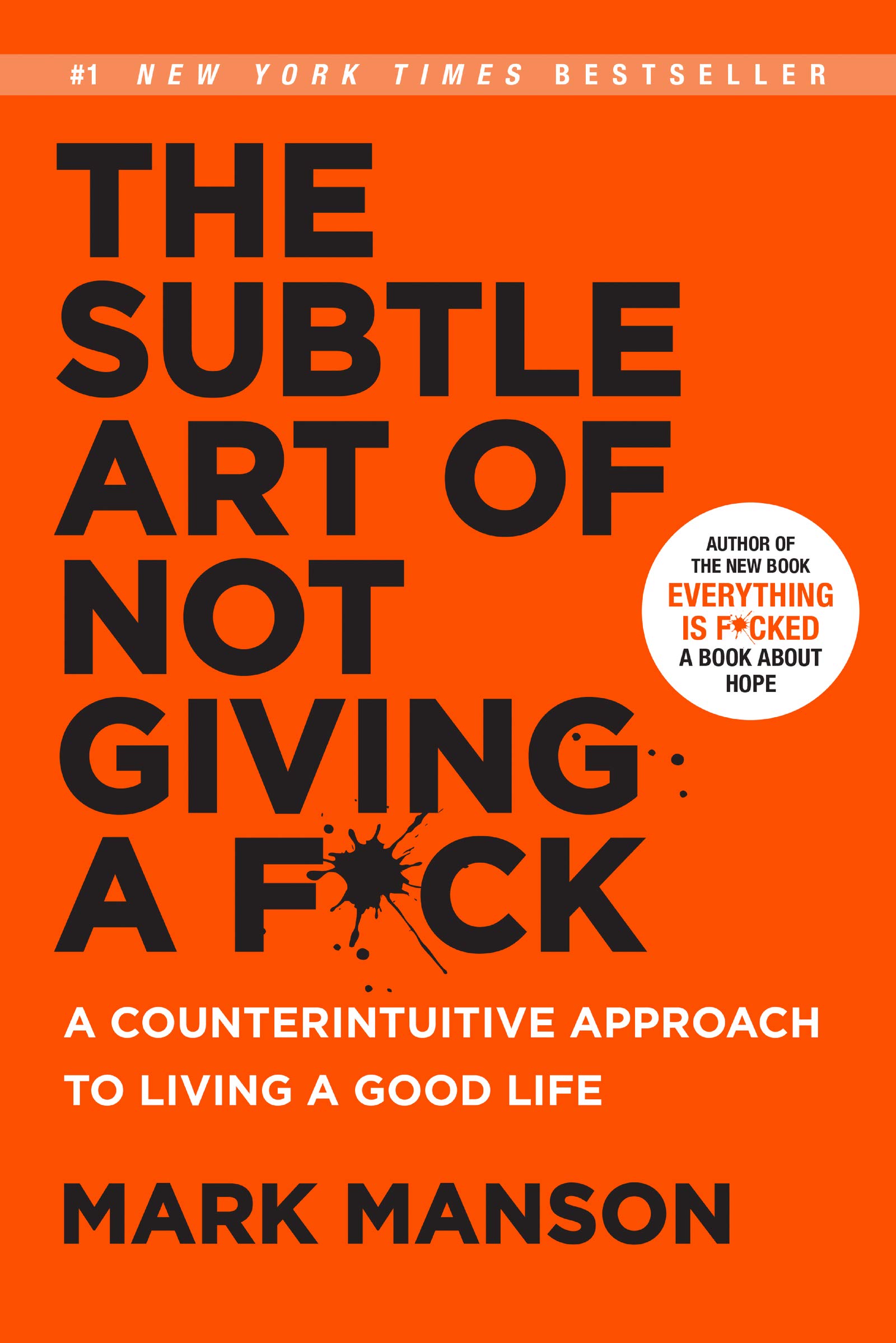
The Subtle Art of Not Giving a F*ck: A Counterintuitive Approach to Living a Good Life (Mark Manson Collection Book 1)
Metadata
- Title: The Subtle Art of Not Giving a F*ck: A Counterintuitive Approach to Living a Good Life (Mark Manson Collection Book 1)
- Author: Mark Manson
- Book URL: https://amazon.com/dp/B019MMUA8S?tag=malvaonlin-20
- Open in Kindle: kindle://book/?action=open&asin=B019MMUA8S
- Last Updated on: Monday, November 11, 2019
Highlights & Notes
Self-improvement and success often occur together. But that doesn’t necessarily mean they’re the same thing.
After all, no truly happy person feels the need to stand in front of a mirror and recite that she’s happy. She just is.
The key to a good life is not giving a fuck about more; it’s giving a fuck about less, giving a fuck about only what is true and immediate and important.
Very few animals on earth have the ability to think cogent thoughts to begin with, but we humans have the luxury of being able to have thoughts about our thoughts. So I can think about watching Miley Cyrus videos on YouTube, and then immediately think about what a sicko I am for wanting to watch Miley Cyrus videos on YouTube. Ah, the miracle of consciousness!
Our society today, through the wonders of consumer culture and hey-look-my-life-is-cooler-than-yours social media, has bred a whole generation of people who believe that having these negative experiences—anxiety, fear, guilt, etc.—is totally not okay. I mean, if you look at your Facebook feed, everybody there is having a fucking grand old time. Look, eight people got married this week! And some sixteen-year-old on TV got a Ferrari for her birthday. And another kid just made two billion dollars inventing an app that automatically delivers you more toilet paper when you run out.
Now if you feel like shit for even five minutes, you’re bombarded with 350 images of people totally happy and having amazing fucking lives, and it’s impossible to not feel like there’s something wrong with you. It’s this last part that gets us into trouble. We feel bad about feeling bad. We feel guilty for feeling guilty. We get angry about getting angry. We get anxious about feeling anxious. What is wrong with me?
By not giving a fuck that you feel bad, you short-circuit the Feedback Loop from Hell; you say to yourself, “I feel like shit, but who gives a fuck?” And then, as if sprinkled by magic fuck-giving fairy dust, you stop hating yourself for feeling so bad.
Stress-related health issues, anxiety disorders, and cases of depression have skyrocketed over the past thirty years, despite the fact that everyone has a flat-screen TV and can have their groceries delivered. Our crisis is no longer material; it’s existential, it’s spiritual.
The desire for more positive experience is itself a negative experience. And, paradoxically, the acceptance of one’s negative experience is itself a positive experience.
Wanting positive experience is a negative experience; accepting negative experience is a positive experience.
—the idea that the more you pursue feeling better all the time, the less satisfied you become, as pursuing something only reinforces the fact that you lack it in the first place.
“You will never be happy if you continue to search for what happiness consists of. You will never live if you are looking for the meaning of life.”
Ever notice that sometimes when you care less about something, you do better at it? Notice how it’s often the person who is the least invested in the success of something that actually ends up achieving it?
If pursuing the positive is a negative, then pursuing the negative generates the positive. The pain you pursue in the gym results in better all-around health and energy. The failures in business are what lead to a better understanding of what’s necessary to be successful. Being open with your insecurities paradoxically makes you more confident and charismatic around others. The pain of honest confrontation is what generates the greatest trust and respect in your relationships. Suffering through your fears and anxieties is what allows you to build courage and perseverance.
Everything worthwhile in life is won through surmounting the associated negative experience.
The avoidance of suffering is a form of suffering. The avoidance of struggle is a struggle. The denial of failure is a failure. Hiding what is shameful is itself a form of shame.
To not give a fuck is to stare down life’s most terrifying and difficult challenges and still take action.
learning how to focus and prioritize your thoughts effectively—how to pick and choose what matters to you and what does not matter to you based on finely honed personal values. This is incredibly difficult.
Subtlety #1: Not giving a fuck does not mean being indifferent; it means being comfortable with being different.
Because here’s another sneaky little truth about life. You can’t be an important and life-changing presence for some people without also being a joke and an embarrassment to others. You just can’t.
No matter where you go, there’s a five-hundred-pound load of shit waiting for you. And that’s perfectly fine. The point isn’t to get away from the shit. The point is to find the shit you enjoy dealing with.
Subtlety #2: To not give a fuck about adversity, you must first give a fuck about something more important than adversity.
It then follows that finding something important and meaningful in your life is perhaps the most productive use of your time and energy. Because if you don’t find that meaningful something, your fucks will be given to meaningless and frivolous causes.
Subtlety #3: Whether you realize it or not, you are always choosing what to give a fuck about.
I see practical enlightenment as becoming comfortable with the idea that some suffering is always inevitable—that no matter what you do, life is comprised of failures, loss, regrets, and even death. Because once you become comfortable with all the shit that life throws at you (and it will throw a lot of shit, trust me), you become invincible in a sort of low-level spiritual way.
Instead, this book will turn your pain into a tool, your trauma into power, and your problems into slightly better problems. That is real progress. Think of it as a guide to suffering and how to do it better, more meaningfully, with more compassion and more humility. It’s a book about moving lightly despite your heavy burdens, resting easier with your greatest fears, laughing at your tears as you cry them.
One of those realizations was this: that life itself is a form of suffering. The rich suffer because of their riches. The poor suffer because of their poverty. People without a family suffer because they have no family. People with a family suffer because of their family. People who pursue worldly pleasures suffer because of their worldly pleasures. People who abstain from worldly pleasures suffer because of their abstention.
that pain and loss are inevitable and we should let go of trying to resist them.
There is a premise that underlies a lot of our assumptions and beliefs. The premise is that happiness is algorithmic, that it can be worked for and earned and achieved as if it were getting accepted to law school or building a really complicated Lego set. If I achieve X, then I can be happy. If I look like Y, then I can be happy. If I can be with a person like Z, then I can be happy.
This premise, though, is the problem. Happiness is not a solvable equation. Dissatisfaction and unease are inherent parts of human nature and, as we’ll see, necessary components to creating consistent happiness.
After all, the greatest truths in life are usually the most unpleasant to hear.
We suffer for the simple reason that suffering is biologically useful. It is nature’s preferred agent for inspiring change.
Like physical pain, our psychological pain is an indication of something out of equilibrium, some limitation that has been exceeded. And like our physical pain, our psychological pain is not necessarily always bad or even undesirable. In some cases, experiencing emotional or psychological pain can be healthy or necessary.
we lose the benefits of experiencing healthy doses of pain, a loss that disconnects us from the reality of the world around us.
Problems are a constant in life. When you solve your health problem by buying a gym membership, you create new problems, like having to get up early to get to the gym on time,
Problems never stop; they merely get exchanged and/or upgraded. Happiness comes from solving problems. The keyword here is “solving.” If you’re avoiding your problems or feel like you don’t have any problems, then you’re going to make yourself miserable.
To be happy we need something to solve. Happiness is therefore a form of action; it’s an activity, not something that is passively bestowed upon you, not something that you magically discover in a top-ten article on the Huffington Post or from any specific guru or teacher.
True happiness occurs only when you find the problems you enjoy having and enjoy solving.
1. Denial. Some people deny that their problems exist in the first place. And because they deny reality, they must constantly delude or distract themselves from reality. This may make them feel good in the short term, but it leads to a life of insecurity, neuroticism, and emotional repression.
2. Victim Mentality. Some choose to believe that there is nothing they can do to solve their problems, even when they in fact could. Victims seek to blame others for their problems or blame outside circumstances. This may make them feel better in the short term, but it leads to a life of anger, helplessness, and despair.
Emotions are simply biological signals designed to nudge you in the direction of beneficial change.
In other words, negative emotions are a call to action. When you feel them, it’s because you’re supposed to do something. Positive emotions, on the other hand, are rewards for taking the proper action.
Emotions are part of the equation of our lives, but not the entire equation. Just because something feels good doesn’t mean it is good. Just because something feels bad doesn’t mean it is bad. Emotions are merely signposts, suggestions that our neurobiology gives us, not commandments. Therefore, we shouldn’t always trust our own emotions. In fact, I believe we should make a habit of questioning them.
Decision-making based on emotional intuition, without the aid of reason to keep it in line, pretty much always sucks.
We like the idea that there’s some form of ultimate happiness that can be attained. We like the idea that we can alleviate all of our suffering permanently. We like the idea that we can feel fulfilled and satisfied with our lives forever. But we cannot.
“What pain do you want in your life? What are you willing to struggle for?” Because that seems to be a greater determinant of how our lives turn out.
Because happiness requires struggle. It grows from problems. Joy doesn’t just sprout out of the ground like daisies and rainbows. Real, serious, lifelong fulfillment and meaning have to be earned through the choosing and managing of our struggles.
And what it took me a long time to discover is that I didn’t like to climb much. I just liked to imagine the summit.
I wanted the reward and not the struggle. I wanted the result and not the process. I was in love with not the fight but only the victory. And life doesn’t work that way.
Who you are is defined by what you’re willing to struggle for.
our struggles determine our successes. Our problems birth our happiness, along with slightly better, slightly upgraded problems.
The problem with the self-esteem movement is that it measured self-esteem by how positively people felt about themselves. But a true and accurate measurement of one’s self-worth is how people feel about the negative aspects of themselves.
Jimmy is entitled. That is, he feels as though he deserves good things without actually earning them. He believes he should be able to be rich without actually working for it. He believes he should be liked and well-connected without actually helping anyone. He believes he should have an amazing lifestyle without actually sacrificing anything.
But the problem with entitlement is that it makes people need to feel good about themselves all the time, even at the expense of those around them.
The true measurement of self-worth is not how a person feels about her positive experiences, but rather how she feels about her negative experiences.
A person who actually has a high self-worth is able to look at the negative parts of his character frankly—“Yes, sometimes I’m irresponsible with money,” “Yes, sometimes I exaggerate my own successes,” “Yes, I rely too much on others to support me and should be more self-reliant”—and then acts to improve upon them. But entitled people, because they are incapable of acknowledging their own problems openly and honestly, are incapable of improving their lives in any lasting or meaningful way.
If we have problems that are unsolvable, our unconscious figures that we’re either uniquely special or uniquely defective in some way. That we’re somehow unlike everyone else and that the rules must be different for us. Put simply: we become entitled.
1. I’m awesome and the rest of you all suck, so I deserve special treatment. 2. I suck and the rest of you are all awesome, so I deserve special treatment.
It just means that you’re not special. Often, it’s this realization—that you and your problems are actually not privileged in their severity or pain—that is the first and most important step toward solving them.
The easier and more problem-free our lives become, the more we seem to feel entitled for them to get even better.
Our lives today are filled with information from the extremes of the bell curve of human experience, because in the media business that’s what gets eyeballs, and eyeballs bring dollars.
Technology has solved old economic problems by giving us new psychological problems. The Internet has not just open-sourced information; it has also open-sourced insecurity, self-doubt, and shame.
The fact that this statement is inherently contradictory—after all, if everyone were extraordinary, then by definition no one would be extraordinary—is missed by most people. And instead of questioning what we actually deserve or don’t deserve, we eat the message up and ask for more.
To both men, their suffering meant something; it fulfilled some greater cause. And because it meant something, they were able to endure it, or perhaps even enjoy it.
If suffering is inevitable, if our problems in life are unavoidable, then the question we should be asking is not “How do I stop suffering?” but “Why am I suffering—for what purpose?”
because our values determine the nature of our problems, and the nature of our problems determines the quality of our lives.
Everything we think and feel about a situation ultimately comes back to how valuable we perceive it to be.
Problems may be inevitable, but the meaning of each problem is not. We get to control what our problems mean based on how we choose to think about them, the standard by which we choose to measure them.
Our values determine the metrics by which we measure ourselves and everyone else.
If you want to change how you see your problems, you have to change what you value and/or how you measure failure/success.
These stories suggest that some values and metrics are better than others. Some lead to good problems that are easily and regularly solved. Others lead to bad problems that are not easily and regularly solved.
Pleasure. Pleasure is great, but it’s a horrible value to prioritize your life around. Ask any drug addict how his pursuit of pleasure turned out.
Material Success. Many people measure their self-worth based on how much money they make or what kind of car they drive or whether their front lawn is greener and prettier than the next-door neighbor’s. Research shows that once one is able to provide for basic physical needs (food, shelter, and so on), the correlation between happiness and worldly success quickly approaches zero.
The other issue with overvaluing material success is the danger of prioritizing it over other values, such as honesty, nonviolence, and compassion. When people measure themselves not by their behavior, but by the status symbols they’re able to collect, then not only are they shallow, but they’re probably assholes as well.
The fact is, people who base their self-worth on being right about everything prevent themselves from learning from their mistakes. They lack the ability to take on new perspectives and empathize with others. They close themselves off to new and important information. It’s far more helpful to assume that you’re ignorant and don’t know a whole lot. This keeps you unattached to superstitious or poorly informed beliefs and promotes a constant state of learning and growth.
Denying negative emotions leads to experiencing deeper and more prolonged negative emotions and to emotional dysfunction. Constant positivity is a form of avoidance, not a valid solution to life’s problems—problems which, by the way, if you’re choosing the right values and metrics, should be invigorating you and motivating you.
“One day, in retrospect, the years of struggle will strike you as the most beautiful.”
Good values are 1) reality-based, 2) socially constructive, and 3) immediate and controllable. Bad values are 1) superstitious, 2) socially destructive, and 3) not immediate or controllable.
Some examples of good, healthy values: honesty, innovation, vulnerability, standing up for oneself, standing up for others, self-respect, curiosity, charity, humility, creativity.
Some examples of bad, unhealthy values: dominance through manipulation or violence, indiscriminate fucking, feeling good all the time, always being the center of attention, not being alone, being liked by everybody, being rich for the sake of being rich, sacrificing small animals to the pagan gods.
This, in a nutshell, is what “self-improvement” is really about: prioritizing better values, choosing better things to give a fuck about. Because when you give better fucks, you get better problems. And when you get better problems, you get a better life.
radical form of responsibility: taking responsibility for everything that occurs in your life, regardless of who’s at fault.
uncertainty: the acknowledgement of your own ignorance and the cultivation of constant doubt in your own beliefs.
failure: the willingness to discover your own flaws and mistakes so that they may be improved upon.
rejection: the ability to both say and hear no, thus clearly defining what you will and will not accept in your life.
contemplation of one’s own mortality; this one is crucial, because paying vigilant attention to one’s own death is perhaps the only thing capable of helping us keep all our other values in proper perspective.
Often the only difference between a problem being painful or being powerful is a sense that we chose it, and that we are responsible for it. If you’re miserable in your current situation, chances are it’s because you feel like some part of it is outside your control—that there’s a problem you have no ability to solve, a problem that was somehow thrust upon you without your choosing. When we feel that we’re choosing our problems, we feel empowered. When we feel that our problems are being forced upon us against our will, we feel victimized and miserable.
There is a simple realization from which all personal improvement and growth emerges. This is the realization that we, individually, are responsible for everything in our lives, no matter the external circumstances. We don’t always control what happens to us. But we always control how we interpret what happens to us, as well as how we respond.
Whether we like it or not, we are always taking an active role in what’s occurring to and within us. We are always interpreting the meaning of every moment and every occurrence. We are always choosing the values by which we live and the metrics by which we measure everything that happens to us. Often the same event can be good or bad, depending on the metric we choose to use.
The more we choose to accept responsibility in our lives, the more power we will exercise over our lives. Accepting responsibility for our problems is thus the first step to solving them.
A lot of people hesitate to take responsibility for their problems because they believe that to be responsible for your problems is to also be at fault for your problems.
There’s a difference between blaming someone else for your situation and that person’s actually being responsible for your situation. Nobody else is ever responsible for your situation but you. Many people may be to blame for your unhappiness, but nobody is ever responsible for your unhappiness but you. This is because you always get to choose how you see things, how you react to things, how you value things. You always get to choose the metric by which to measure your experiences.
We all love to take responsibility for success and happiness. Hell, we often fight over who gets to be responsible for success and happiness. But taking responsibility for our problems is far more important, because that’s where the real learning comes from. That’s where the real-life improvement comes from. To simply blame others is only to hurt yourself.
You are already choosing, in every moment of every day, what to give a fuck about, so change is as simple as choosing to give a fuck about something else. It really is that simple. It’s just not easy.
Growth is an endlessly iterative process.
Our values are our hypotheses: this behavior is good and important; that other behavior is not. Our actions are the experiments; the resulting emotions and thought patterns are our data.
There is no correct dogma or perfect ideology. There is only what your experience has shown you to be right for you—and even then, that experience is probably somewhat wrong too.
Many people become so obsessed with being “right” about their life that they never end up actually living it.
But that’s not it. Sure, rejection hurts. Failure sucks. But there are particular certainties that we hold on to—certainties that we’re afraid to question or let go of, values that have given our lives meaning over the years.
Certainty is the enemy of growth. Nothing is for certain until it has already happened—and even then, it’s still debatable. That’s why accepting the inevitable imperfections of our values is necessary for any growth to take place.
Instead of striving for certainty, we should be in constant search of doubt: doubt about our own beliefs, doubt about our own feelings, doubt about what the future may hold for us unless we get out there and create it for ourselves. Instead of looking to be right all the time, we should be looking for how we’re wrong all the time. Because we are.
Being wrong opens us up to the possibility of change. Being wrong brings the opportunity for growth.
Because here’s something that’s weird but true: we don’t actually know what a positive or negative experience is. Some of the most difficult and stressful moments of our lives also end up being the most formative and motivating. Some of the best and most gratifying experiences of our lives are also the most distracting and demotivating. Don’t trust your conception of positive/negative experiences. All that we know for certain is what hurts in the moment and what doesn’t. And that’s not worth much.
Sadism aside, the point of the experiment is to show how quickly the human mind is capable of coming up with and believing in a bunch of bullshit that isn’t real.
Our brains are meaning machines. What we understand as “meaning” is generated by the associations our brain makes between two or more experiences. We press a button, then we see a light go on; we assume the button caused the light to go on. This, at its core, is the basis of meaning. Button, light; light, button.
First, the brain is imperfect. We mistake things we see and hear. We forget things or misinterpret events quite easily. Second, once we create meaning for ourselves, our brains are designed to hold on to that meaning. We are biased toward the meaning our mind has made, and we don’t want to let go of it. Even if we see evidence that contradicts the meaning we created, we often ignore it and keep on believing anyway.
Most of our beliefs are wrong. Or, to be more exact, all beliefs are wrong—some are just less wrong than others. The human mind is a jumble of inaccuracy. And while this may make you uncomfortable, it’s an incredibly important concept to accept,
Evil people never believe that they are evil; rather, they believe that everyone else is evil.
The problem here is that not only is certainty unattainable, but the pursuit of certainty often breeds more (and worse) insecurity.
It’s the backwards law again: the more you try to be certain about something, the more uncertain and insecure you will feel.
the more you embrace being uncertain and not knowing, the more comfortable you will feel in knowing what you don’t know.
Uncertainty is the root of all progress and all growth. As the old adage goes, the man who believes he knows everything learns nothing. We cannot learn anything without first not knowing something. The more we admit we do not know, the more opportunities we gain to learn.
Our values are imperfect and incomplete, and to assume that they are perfect and complete is to put us in a dangerously dogmatic mindset that breeds entitlement and avoids responsibility. The only way to solve our problems is to first admit that our actions and beliefs up to this point have been wrong and are not working. This openness to being wrong must exist for any real change or growth to take place.
Before we can look at our values and prioritizations and change them into better, healthier ones, we must first become uncertain of our current values.
The more something threatens your identity, the more you will avoid it.
There’s a certain comfort that comes with knowing how you fit in the world. Anything that shakes up that comfort—even if it could potentially make your life better—is inherently scary.
This is why people are often so afraid of success—for the exact same reason they’re afraid of failure: it threatens who they believe themselves to be.
We all have values for ourselves. We protect these values. We try to live up to them and we justify them and maintain them. Even if we don’t mean to, that’s how our brain is wired.
Until we change how we view ourselves, what we believe we are and are not, we cannot overcome our avoidance and anxiety. We cannot change.
outer opportunities. I say don’t find yourself. I say never know who you are. Because that’s what keeps you striving and discovering. And it forces you to remain humble in your judgments and accepting of the differences in others.
When we let go of the stories we tell about ourselves, to ourselves, we free ourselves up to actually act (and fail) and grow.
The narrower and rarer the identity you choose for yourself, the more everything will seem to threaten you. For that reason, define yourself in the simplest and most ordinary ways possible.
It’s worth remembering that for any change to happen in your life, you must be wrong about something.
That’s because the potential meaning behind our wrongness is often painful. Not only does it call into question our values, but it forces us to consider what a different, contradictory value could potentially look and feel like.
Aristotle wrote, “It is the mark of an educated mind to be able to entertain a thought without accepting it.” Being able to look at and evaluate different values without necessarily adopting them is perhaps the central skill required in changing one’s own life in a meaningful way.
But probing questions are necessary in order to get at the core problems that are motivating his, and our, dickish behavior.
if it feels like it’s you versus the world, chances are it’s really just you versus yourself.
This confines us and stifles us. We can be truly successful only at something we’re willing to fail at. If we’re unwilling to fail, then we’re unwilling to succeed.
It’s only when we feel intense pain that we’re willing to look at our values and question why they seem to be failing us. We need some sort of existential crisis to take an objective look at how we’ve been deriving meaning in our life, and then consider changing course.
I can’t stress this enough, but pain is part of the process. It’s important to feel it. Because if you just chase after highs to cover up the pain, if you continue to indulge in entitlement and delusional positive thinking, if you continue to overindulge in various substances or activities, then you’ll never generate the requisite motivation to actually change.
Learn to sustain the pain you’ve chosen. When you choose a new value, you are choosing to introduce a new form of pain into your life. Relish it. Savor it. Welcome it with open arms. Then act despite it.
Action isn’t just the effect of motivation; it’s also the cause of it.
Ultimately, the only way to achieve meaning and a sense of importance in one’s life is through a rejection of alternatives, a narrowing of freedom, a choice of commitment to one place, one belief, or (gulp) one person.
But we need to reject something. Otherwise, we stand for nothing. If nothing is better or more desirable than anything else, then we are empty and our life is meaningless. We are without values and therefore live our life without any purpose.
The act of choosing a value for yourself requires rejecting alternative values. If I choose to make my marriage the most important part of my life, that means I’m (probably) choosing not to make cocaine-fueled hooker orgies an important part of my life. If I’m choosing to judge myself based on my ability to have open and accepting friendships, that means I’m rejecting trashing my friends behind their backs. These are all healthy decisions, yet they require rejection at every turn.
That rejection is an inherent and necessary part of maintaining our values, and therefore our identity. We are defined by what we choose to reject. And if we reject nothing (perhaps in fear of being rejected by something ourselves), we essentially have no identity at all.
Unhealthy love is based on two people trying to escape their problems through their emotions for each other—in other words, they’re using each other as an escape.
Healthy love is based on two people acknowledging and addressing their own problems with each other’s support.
The difference between a healthy and an unhealthy relationship comes down to two things: 1) how well each person in the relationship accepts responsibility, and 2) the willingness of each person to both reject and be rejected by their partner.
The mark of an unhealthy relationship is two people who try to solve each other’s problems in order to feel good about themselves. Rather, a healthy relationship is when two people solve their own problems in order to feel good about each other.
Entitled people who blame others for their own emotions and actions do so because they believe that if they constantly paint themselves as victims, eventually someone will come along and save them, and they will receive the love they’ve always wanted.
Entitled people who take the blame for other people’s emotions and actions do so because they believe that if they “fix” their partner and save him or her, they will receive the love and appreciation they’ve always wanted.
For victims, the hardest thing to do in the world is to hold themselves accountable for their problems. They’ve spent their whole life believing that others are responsible for their fate. That first step of taking responsibility for themselves is often terrifying.
For savers, the hardest thing to do in the world is to stop taking responsibility for other people’s problems. They’ve spent their whole life feeling valued and loved only when they’re saving somebody else—so letting go of this need is terrifying to them as well.
Acts of love are valid only if they’re performed without conditions or expectations.
People with strong boundaries understand that it’s unreasonable to expect two people to accommodate each other 100 percent and fulfill every need the other has. People with strong boundaries understand that they may hurt someone’s feelings sometimes, but ultimately they can’t determine how other people feel. People with strong boundaries understand that a healthy relationship is not about controlling one another’s emotions, but rather about each partner supporting the other in their individual growth and in solving their own problems.
It’s not about giving a fuck about everything your partner gives a fuck about; it’s about giving a fuck about your partner regardless of the fucks he or she gives. That’s unconditional love, baby.
When trust is destroyed, it can be rebuilt only if the following two steps happen: 1) the trust-breaker admits the true values that caused the breach and owns up to them, and 2) the trust-breaker builds a solid track record of improved behavior over time. Without the first step, there should be no attempt at reconciliation in the first place.
Commitment gives you freedom because you’re no longer distracted by the unimportant and frivolous. Commitment gives you freedom because it hones your attention and focus, directing them toward what is most efficient at making you healthy and happy. Commitment makes decision-making easier and removes any fear of missing out; knowing that what you already have is good enough, why would you ever stress about chasing more, more, more again? Commitment allows you to focus intently on a few highly important goals and achieve a greater degree of success than you otherwise would.
In this way, the rejection of alternatives liberates us—rejection of what does not align with our most important values, with our chosen metrics, rejection of the constant pursuit of breadth without depth.
Yet, in a bizarre, backwards way, death is the light by which the shadow of all of life’s meaning is measured. Without death, everything would feel inconsequential, all experience arbitrary, all metrics and values suddenly zero.
While death is bad, it is inevitable. Therefore, we should not avoid this realization, but rather come to terms with it as best we can. Because once we become comfortable with the fact of our own death—the root terror, the underlying anxiety motivating all of life’s frivolous ambitions—we can then choose our values more freely, unrestrained by the illogical quest for immortality, and freed from dangerous dogmatic views.
The Stoics of ancient Greece and Rome implored people to keep death in mind at all times, in order to appreciate life more and remain humble in the face of its adversities.
“The fear of death follows from the fear of life. A man who lives fully is prepared to die at any time.”
Confronting the reality of our own mortality is important because it obliterates all the crappy, fragile, superficial values in life.
How will the world be different and better when you’re gone? What mark will you have made? What influence will you have caused? They say that a butterfly flapping its wings in Africa can cause a hurricane in Florida; well, what hurricanes will you leave in your wake?
Without acknowledging the ever-present gaze of death, the superficial will appear important, and the important will appear superficial.
The only way to be comfortable with death is to understand and see yourself as something bigger than yourself; to choose values that stretch beyond serving yourself, that are simple and immediate and controllable and tolerant of the chaotic world around you. This is the basic root of all happiness.
It’s these dynamics that plague us now. We are so materially well off, yet so psychologically tormented in so many low-level and shallow ways. People relinquish all responsibility, demanding that society cater to their feelings and sensibilities. People hold on to arbitrary certainties and try to enforce them on others, often violently, in the name of some made-up righteous cause. People, high on a sense of false superiority, fall into inaction and lethargy for fear of trying something worthwhile and failing at it.
The pampering of the modern mind has resulted in a population that feels deserving of something without earning that something, a population that feels they have a right to something without sacrificing for
You are already great because in the face of endless confusion and certain death, you continue to choose what to give a fuck about and what not to. This mere fact, this simple optioning for your own values in life, already makes you beautiful, already makes you successful, and already makes you loved. Even if you don’t realize it. Even if you’re sleeping in a gutter and starving.
You too are going to die, and that’s because you too were fortunate enough to have lived.
there is nothing to be afraid of. Ever.
The more I peer into the darkness, the brighter life gets, the quieter the world becomes, and the less unconscious resistance I feel to, well, anything.
No, the opposite of happiness is hopelessness, an endless gray horizon of resignation and indifference.3 It’s the belief that everything is fucked, so why do anything at all?
Hopelessness is the root of anxiety, mental illness, and depression. It is the source of all misery and the cause of all addiction. This is not an overstatement.4 Chronic anxiety is a crisis of hope. It is the fear of a failed future. Depression is a crisis of hope. It is the belief in a meaningless future. Delusion, addiction, obsession—these are all the mind’s desperate and compulsive attempts at generating hope one neurotic tic or obsessive craving at a time.