Thrive: The Vegan Nutrition Guide to Optimal Performance in Sports and Life
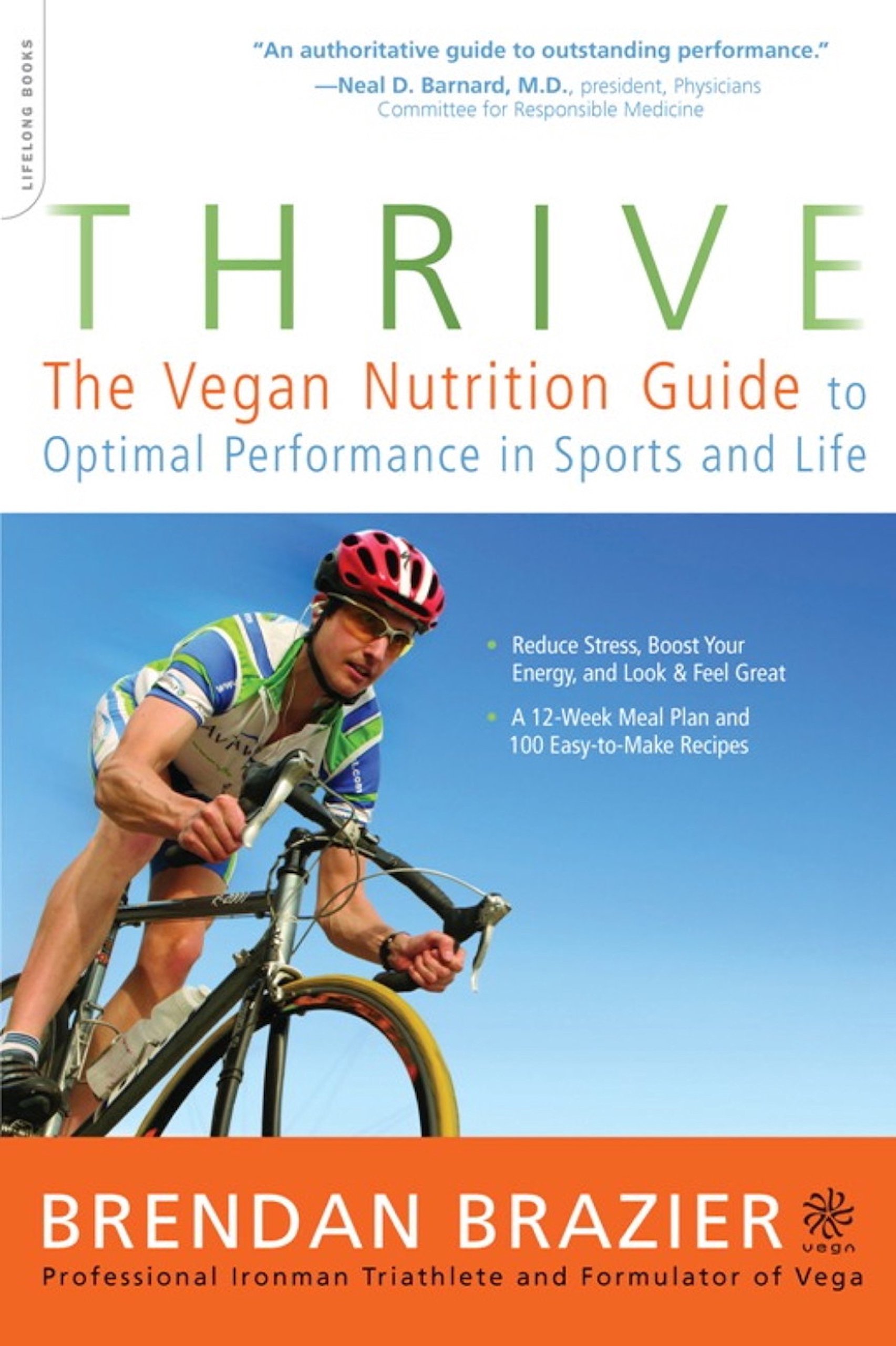
Metadata
- Title: Thrive: The Vegan Nutrition Guide to Optimal Performance in Sports and Life
- Author: Brendan Brazier and Hugh Jackman
- Book URL: https://amazon.com/dp/B004GB1FTY?tag=malvaonlin-20
- Open in Kindle: kindle://book/?action=open&asin=B004GB1FTY
- Last Updated on: Wednesday, November 18, 2015
Highlights & Notes
While training programs are meticulously plotted and each workout is planned in detail, little thought is given to recovery. We know that recovery occurs when the body is at rest, but, as I learned, there are varying states of rest that are not well understood. Maximizing the quality of rest is key. Removing other forms of stress from the body during times of rest will speed the rate of recovery. In doing so, the athlete will be better physiologically prepared for the next workout and therefore will benefit from it more.
The Thrive Diet aims to: • reduce biological age, • increase life expectancy, • help reduce body fat and maintain lean muscle, • increase energy without coffee or sugar, • increase strength and endurance, • improve productivity, • improve mental clarity, • improve sleep quality, • reduce sleep requirements, • improve resistance to infection, • quicken recovery from exercise, • reduce or eliminate sugar cravings, • increase desire to excel.
Stress is like fire: When controlled and used for a purpose, it serves us well. Left unbridled, it can consume us. In amounts that our body is capable of adapting to, certain stresses are beneficial. Exercise, for example, is a stress. Exercise and then rest, and your body will grow stronger. However, stress has become, now more than ever, a real threat to our health and livelihood, often overwhelming us and, in some cases, even controlling us.
Because of the release of cortisol in reaction to the onset of stress, our body actually gains energy. We become more alert, our strength may increase, and we are able to process information more quickly and react slightly faster than usual. This is an innate defense mechanism. Drawing on its primal roots, our body assumes that if it is stressed, it must be in danger.
The threats to early humans may have been more immediate threats than ours, yet our stress-response mechanism today remains much the same. In modern Western society, rarely is it put to its original use of self-preservation. Our daily threats pale in comparison to being attacked by an animal or having to scour long and hard for food. But although our threats may be less dire, they are greater in number—far greater—and cumulative.
Stressed people do not burn body fat as fuel as efficiently as do those who are not stressed.
Amino acids, found in unrefined protein, are our body’s prime construction foods. Essential fatty acids are also vital for healthy brain construction and function. Glucose and fructose, two sugars found in fruit, are the brain’s preferred source of fuel.
It is possible to greatly reduce stress and its debilitating effects without reducing productivity; in fact, productivity will improve if the right stressors are removed. Energy improvement, ability to recover from exercise quickly, and a healthy body weight are just a few of the benefits of removing uncomplementary stress.
Uncomplementary stress is the term I use to describe anxiety that produces no benefit. This type of stress should be eliminated or at least reduced as much as possible, since there is nothing to be gained by it.
While personality is a factor, it now seems that there is more to it than that. Regardless of the desire to excel, if a person is forced to deal with mounting stress, that stress can cause motivation to flicker or extinguish altogether.
Exercise is also complementary in its ability to raise the body’s tolerance to physical activity. If a person exercises regularly and is in fair shape, everyday physical activities will not produce a stress response. This is significant. Here’s why. If someone who exercises regularly walks up a few flights of stairs, for example, the strain from doing so will be far below what the body is accustomed to enduring in a workout. The strain on the body from ascending the stairs will not even be noticeable, meaning no stress response. Cortisol, the body’s stress-fighting hormone, will not rise, and the immune system will not in turn decline. A fit person who engages in even minor physical activity will be less likely to succumb to ailments than will a person who does not exercise consistently.
Exercise creates a complementary circle: It activates the natural healing and regeneration process of the body.
Many people put up with things that are unpleasant but tolerable, rather than changing them; their situation needs to become unbearable before they take action. So, in effect, an unbearable job is better than one that is simply dissatisfying, since it will be the catalyst for change.
Production stress is the stress created when you strive to achieve a goal. Ranging from physically demanding training sessions for an athletic competition or working overtime on an important project to sorting out family problems or taking a calculated risk, production stress is not something to shy away from. Sometimes referred to as the “high achiever’s syndrome,” production stress, as its name implies, is an unavoidable by-product of a productive life, a necessary part of modern-day success.
Whatever the circumstances, bringing on production stress by way of striving to achieve something and getting rid of the uncomplementary stress is a sound strategy that I recommend to anyone.
However, if this borrowing strategy is used too often, it will lose its effectiveness and simply become another form of uncomplementary stress. To be effective, the strategy can be used only a few times a month, once a week at most, for those times when a boost would really be beneficial.
I consider coffee drinking an uncomplementary stress. I view it as a form of credit, similar to shopping with a credit card. You get energy now that you don’t actually have, but you pay for it later—when the “bill,” or fatigue, hits. (Simply drinking more coffee to put off the inevitable is like paying off one credit card with another: It will catch up with you sooner or later.)
- oh no!
The body gets energy from food by way of nutrients. The more energy the body must expend to digest, assimilate, and utilize the nutrients in the food we give it, the less energy we are left with.
The nutritional value of food stated on the food packaging label refers to what is in the food—not what the body actually gets from it. The digestion process requires energy, a large portion of which is expelled as heat.
I am often asked how I am able to gain and maintain strength and lean muscle, and have an abundance of energy for high-performance training, while eating fewer calories than most people. One of the most important factors is that I select food with the net-gain concept in mind rather than by the conventional calorie-counting method.
Although commonly referred to as a grain, pseudograins are actually seeds. Higher in protein, fiber, and trace minerals than grains, pseudograins are also gluten-free. The ones I use most frequently in my recipes are amaranth, buckwheat, and quinoa.
primarily foods that are— • raw or cooked at low temperature, • naturally alkaline-forming foods to pH balance the body (discussed later in this chapter, on page 47), • high in nutrients the body can use without having to convert them (I call this one-step nutrition), • nutrient-dense whole foods, • vitamin- and mineral-rich, from whole-food sources, • non-stimulating, to recalibrate the body and eliminate biological debt.
Without enzymes, food cannot be turned into usable fuel for the body. As with hormones, enzyme production in the body diminishes with age, leaving us reliant on diet to provide them.
Consuming a daily dose of raw foods, reducing uncomplementary stress through proper nutrition, and avoiding enzyme-depleting foods such as starchy and deep-fried products are all important principles of the diet.
In addition to these serious concerns, viruses and bacteria are able to thrive in an acidic body, again possibly leading to numerous diseases. Interestingly, it is impossible for cancer to develop in an alkaline environment; this shows the importance of alkalinity in disease prevention.
So, the first two questions consider the food’s manufacturing. The less altered by processing and cooking, the better.
Natural proteins with a relatively high pH include sprouts (any kind—nuts, seeds, legumes); algae such as chlorella and spirulina; grasses such as wheat, oat, and barley; cooked legumes (though cooked legumes are not as alkaline-forming as sprouted legumes); flaxseeds and hemp. Hemp protein, for example, is not isolated and so remains in a relatively natural state, retaining its alkalinity. Also, hemp is raw, another factor contributing to its higher pH.
Other ways of encouraging alkalinity within the body are— • deep-breathing exercises, • yoga, • light stretching, • meditation, • any other activities you enjoy.
One-step nutrition is the term I use to describe food containing nutrients already in a form usable by the body, with no breaking down required. The nutrients get into the body and go straight to work.